


Do you know why newborns need a hepatitis B vaccine?
This seems like more of a controversial question than it should be…
Why All Newborns Need a Hepatitis B Vaccine?
Of course, newborns need a hepatitis B vaccine if they are born to a woman with hepatitis B.
In that situation, they should:
get their first dose of the hepatitis B vaccine within the first 12 hours of life
get a dose of hepatitis B immune globulin (HBIG) for extra protection, within the first 12 hours of life
complete the hepatitis B vaccine series by 6 months
have post-vaccination serologic testing by age 9–12 months
All of which should help ensure that the hepatitis B virus isn’t transmitted to her baby.
Why is that important?
Well, when a newborn or younger infant gets hepatitis B, there is a 90% chance that they will develop a chronic hepatitis B infection. And then, 25% of them will develop liver failure or liver cancer.
That’s why around 3,500 infants would become chronic hepatitis B virus carriers in the United States each year before we had a hepatitis B vaccine. And at least 875 would eventually die from complications like chronic hepatitis, cirrhosis, liver failure, and liver cancer.
Also, with chronic hepatitis B, these children will also be contagious and can get others sick.
Fortunately, that can all be easily prevented when these babies get vaccinated and protected!
That’s not the part that’s controversial though…
Most people understand the need for a birth dose of the hepatitis B vaccine when a pregnant mother has hepatitis B or if the results of testing are unknown.
What they might not understand is why every other baby might need to be vaccinated.
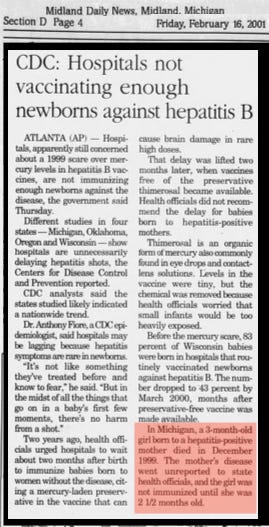
Well, for one thing, when we don’t give all babies a birth dose of hepatitis B, some who should be vaccinated, miss their dose, and they get hepatitis B, a life-threatening infection!
In fact, that’s why we moved to the current universal hepatitis B vaccine policy.
The previous hepatitis B vaccine policies failed.
"Because screening selected pregnant women for HBsAg has failed to identify a high proportion of HBV-infected mothers, prenatal HBsAg testing of all pregnant women is now recommended."
Hepatitis B Virus: A Comprehensive Strategy for Eliminating Transmission in the United States Through Universal Childhood Vaccination: Recommendations of the Immunization Practices Advisory Committee (ACIP)
These policies included selected screening of high risk women(1984); universal testing, with a birth dose of the hepatitis B vaccine if their mother was positive (1987), adding universal vaccination of all infants by age two months (1991); and finally universal vaccination with a birth dose (2005) - the policy that worked best.
Policies that were implemented slowly to help figure out which was safest and most effective.
Why Does Your Newborn Need a Hepatitis B Vaccine?
Is there any other reason that babies should get a hepatitis B vaccine?
How about the fact that some infants and young children develop hepatitis B from other, more casual exposures, after they are born?
“One of the most common myths I hear is that the only way you can get hepatitis B is through IV drug use or sexual activity, and that we know everyone who is infected with hepatitis B or at risk for hepatitis B. That’s just not true.”
Why the hepatitis B vaccine is critical for newborns
In addition to exposure through sex, IV drug use, or when your baby is born, because the hepatitis B virus is relatively stable and can remain viable on most surfaces for at least a week in very small concentrations, you should know that it is possible to get exposed from an infected household contact. This can be a sibling, the child’s father, or other family member or person that frequently visits the home that maybe doesn’t know that they have chronic hepatitis B, which often doesn’t have symptoms until later in life.
In fact, this can happen even if you don’t see visible blood on a contaminated surface!
Rarely, children have even been exposed at daycare.
But what was not rare, before our universal vaccination program, was for some children to develop hepatitis B without any risk factors!
And then there is the simple fact that getting your baby vaccinated ensures that they will be protected when they grow up.
Lastly, since the hepatitis B vaccine is safe, with, there is really no good reason to skip getting it.
Skipping or delaying it, on the other hand, adds unnecessary risk, with no extra benefits for your baby.
More on Hepatitis B Vaccine Schedules
Misinformed Consent about Hepatitis B Vaccines from Aaron Siri
Horizontal transmission of hepatitis B in a children’s day-care centre: a
HBF's Pediatric HBV Screening and Monitoring Recommendations
HBF's Pediatric HBV Management and Treatment Recommendations
Hepatitis B Vaccination is an Essential Safety Net for Newborns