

In a recent testimony before Congress, Secretary RFK Jr argued against the use of a birth dose of the hepatitis B vaccine because he confidently claimed that the death rate in children was practically zero for hepatitis B.
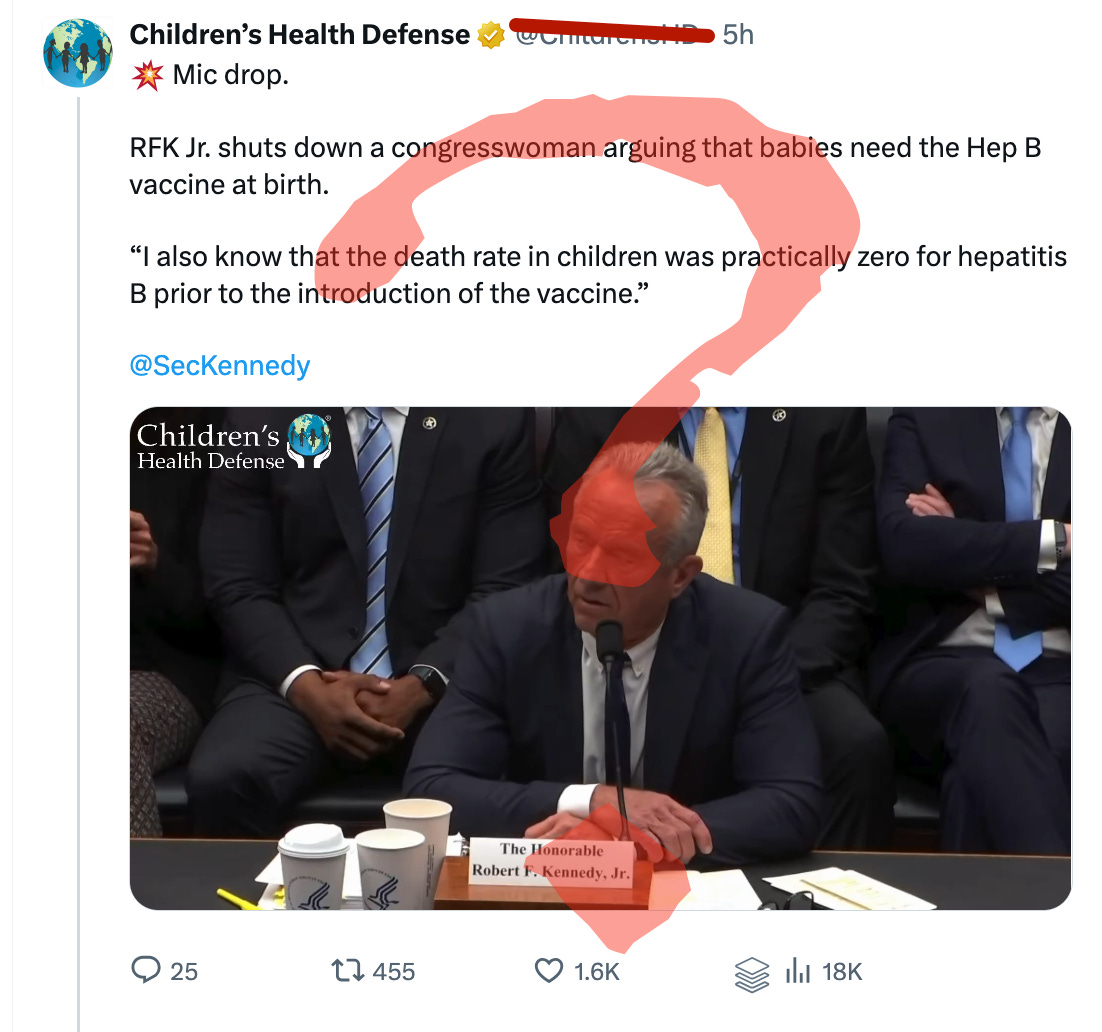
Not surprisingly, like his claims about the death rate for measles in children, this one isn’t true either!
“This report summarizes the results of these analyses, which indicate that many hospitals in Wisconsin have not reinstated policies to ensure routine administration of hepatitis B vaccine to newborns despite the availability of preservative-free hepatitis B vaccine, that the number of hepatitis B vaccine doses given to newborns in Oklahoma and Oregon has declined, and that an unvaccinated Michigan infant died from fulminant hepatitis B. Restoring routine newborn hepatitis B vaccination practices may require active advocacy by professional and government groups.”
Impact of the 1999 AAP/USPHS Joint Statement on Thimerosal in Vaccines on Infant Hepatitis B Vaccination Practices
RFK Jr is forgetting about the infants who can die from fulminant hepatitis B…
“On December 14, 1999, a previously healthy 3-month-old infant was admitted to a hospital with diarrhea and jaundice, and acute hepatic failure attributed to HBV infection was diagnosed. The infant died on December 17, 1999. The infant had not received her first dose of hepatitis B vaccine until age 2.5 months.
The infant’s mother was found to be HBsAg-positive at the first of 10 prenatal visits. However, the prenatal-care record provided to the birth hospital indicated that the mother was hepatitis-negative. Neither the provider nor the laboratory reported the mother’s test results to MDCH as required by law. Before July 1999, the birth hospital had routinely administered hepatitis B vaccine series to newborns before discharge but had discontinued this practice in July 1999 because of concerns about thimerosal.”
Impact of the 1999 AAP/USPHS Joint Statement on Thimerosal in Vaccines on Infant Hepatitis B Vaccination Practices
He’s forgetting about the infant who died in Michigan because the birth dose of the hepatitis B vaccine was suspended over concerns about thimerosal!
What Is the Death Rate for Babies From Hepatitis B?
Still, most babies do not die from hepatitis B.
Then why do we vaccinate babies if hepatitis B isn’t a life-threatening infection?
“As many as 90% of infants who acquire HBV infection from their mothers at birth or in infancy become chronically infected.”
Pink Book: Hepatitis B
Well, that’s because hepatitis B is very much a life-threatening infection!
“Chronic infection is responsible for most HBV-related morbidity and mortality, including chronic hepatitis, cirrhosis, liver failure, and HCC. Approximately 25% of persons who become chronically infected during childhood and 15% of those who become chronically infected after childhood will die prematurely from cirrhosis or liver cancer.”
Pink Book: Hepatitis B
It just doesn’t kill most children when they are young…
“Persons with chronic infection are often asymptomatic and may not be aware they are infected; however, they are capable of infecting others and have been referred to as carriers.”
Pink Book: Hepatitis B
It instead kills them later, after years of being contagious.
It kills them after they develop complications like chronic hepatitis, cirrhosis, liver failure, and liver cancer.
Yes liver cancer!
That’s why the hepatitis B is considered one of our vaccines that helps prevent cancer.
How Many Babies Become Infected With Hepatitis B?
How many children?
Well, thanks to our universal hepatitis B vaccination program, fewer and fewer babies now become infected with hepatitis B at birth.
Before vaccines, it was fairly common though.
Each year, in the United States, around 3,500 infants would become chronic hepatitis B virus carriers.
And at least 875 would eventually die from complications like chronic hepatitis, cirrhosis, liver failure, and liver cancer.
They would die in their 20s-40s.