

With all of the talk of increasing kindergarten vaccine exemption rates and record-breaking outbreaks of measles, some people are likely surprised to learn that vaccination rates generally are still pretty good!
For example, in South Carolina, where we recently had the largest measles outbreak in 35 years, MMR vaccination rates are just over 91%.
And in Utah, where we are currently having the longest measles outbreak in 35 years, MMR vaccination rates are about 88%.
Understanding How Measles Outbreaks Are Happening
Sure, both of those vaccination rates are below the 95% rate that we would like, but they are not so horrible that you would expect to see these kinds of outbreaks, right?
And that’s because it isn’t necessarily immunization rates of 91% or 88% that are causing the large outbreaks we have been seeing!
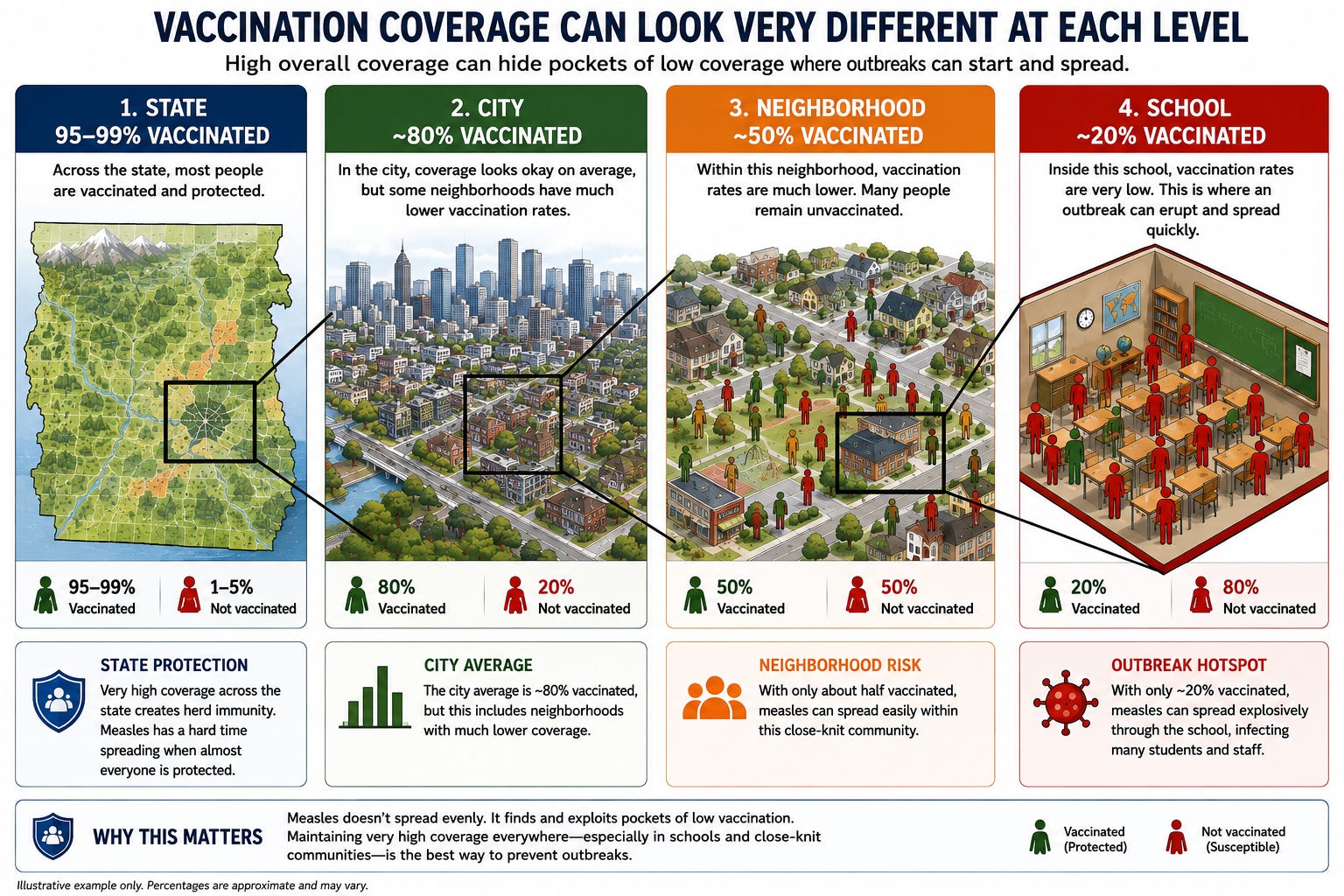
Instead, among the relatively high vaccination coverage rates we might see at the state or city level, we are seeing much lower rates inside many of those cities and communities.
And it is those pockets of susceptible people in those communities that are causing these large outbreaks.
Outbreaks that will continue to grow as they find more of these intentionally unvaccinated groups of people to spread among.
After all, the cycle only stops when everyone finally gets sick or gets vaccinated.
Where Will the Next Measles Outbreak Hit?
That’s why it is important to be prepared and help get more people vaccinated if you live in an at-risk community.
At-risk communities where the next measles outbreak might hit (in addition to where we have had or are having large, outbreaks, like Arizona, Pennsylvania, South Carolina, Texas, and Utah, etc.), including:
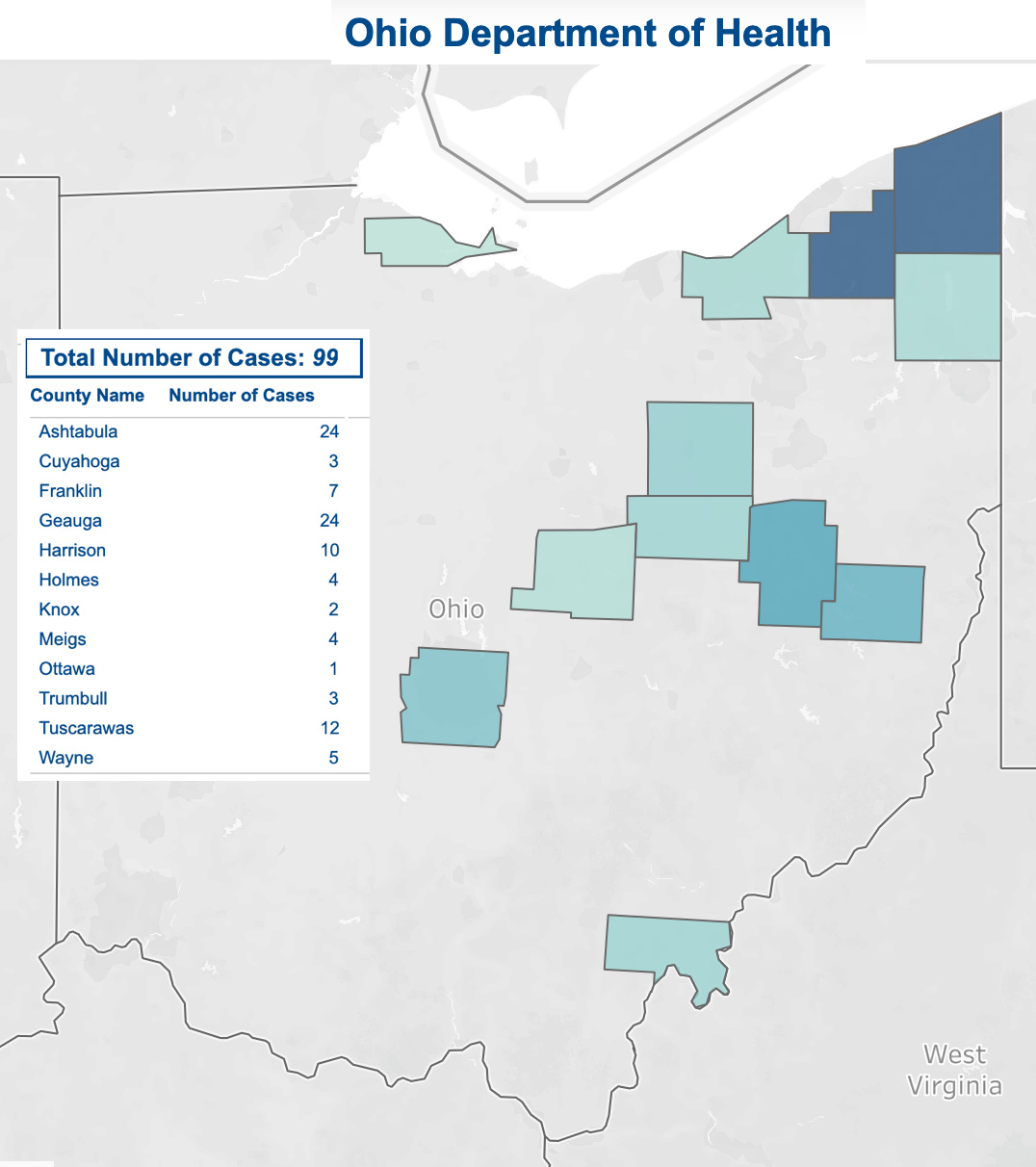
northeastern/central Ohio - a large outbreak here has probably already started in Ashtabula, Geauga, and Tuscarawas Counties, but we will likely see many more cases, especially in Holmes, Wayne, Franklin, and Harrison Counties. Why? This is Ohio Amish country and immunization rates are historically low, as low as 14% for one MMR vaccine! And county level immunization rates are as low as 50%.
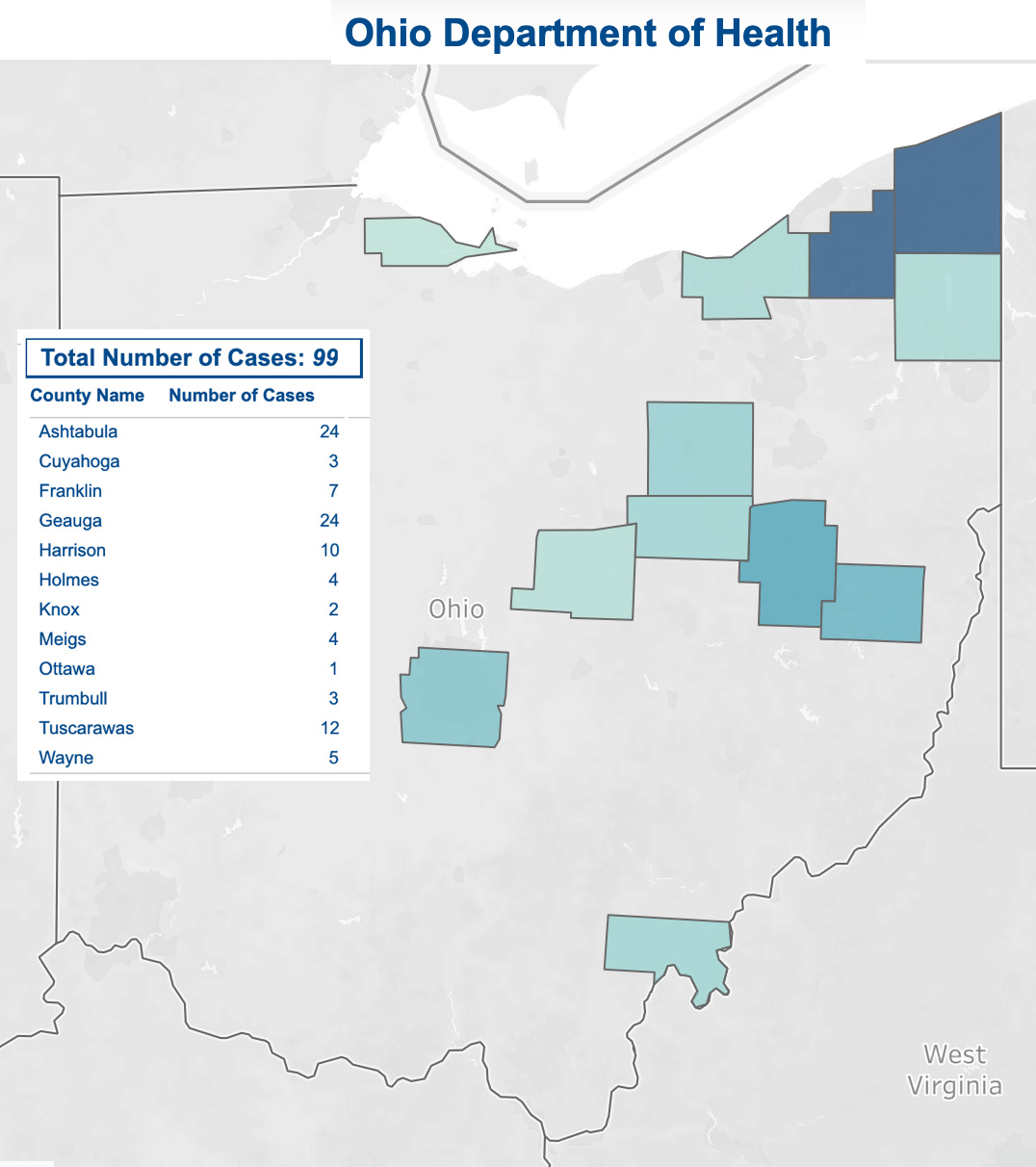
The next big measles outbreak has likely already started in Ohio. northern Indiana - while not usually known as a hotspot for measles, the LaGrange/Elkhart area of northern Indiana has MMR vaccination rates as low as 70%, plus a large Amish community with even lower rates.
northern Maryland - this is another outbreak that has likely started already, with new measles cases in St. Mary’s, Carroll, Cecil, and Charles counties. While overall immunization rates are very good in Maryland, there must still be pockets of susceptibles that aren’t vaccinating, mostly among Amish and Mennonite communities near the Pennsylvania border.
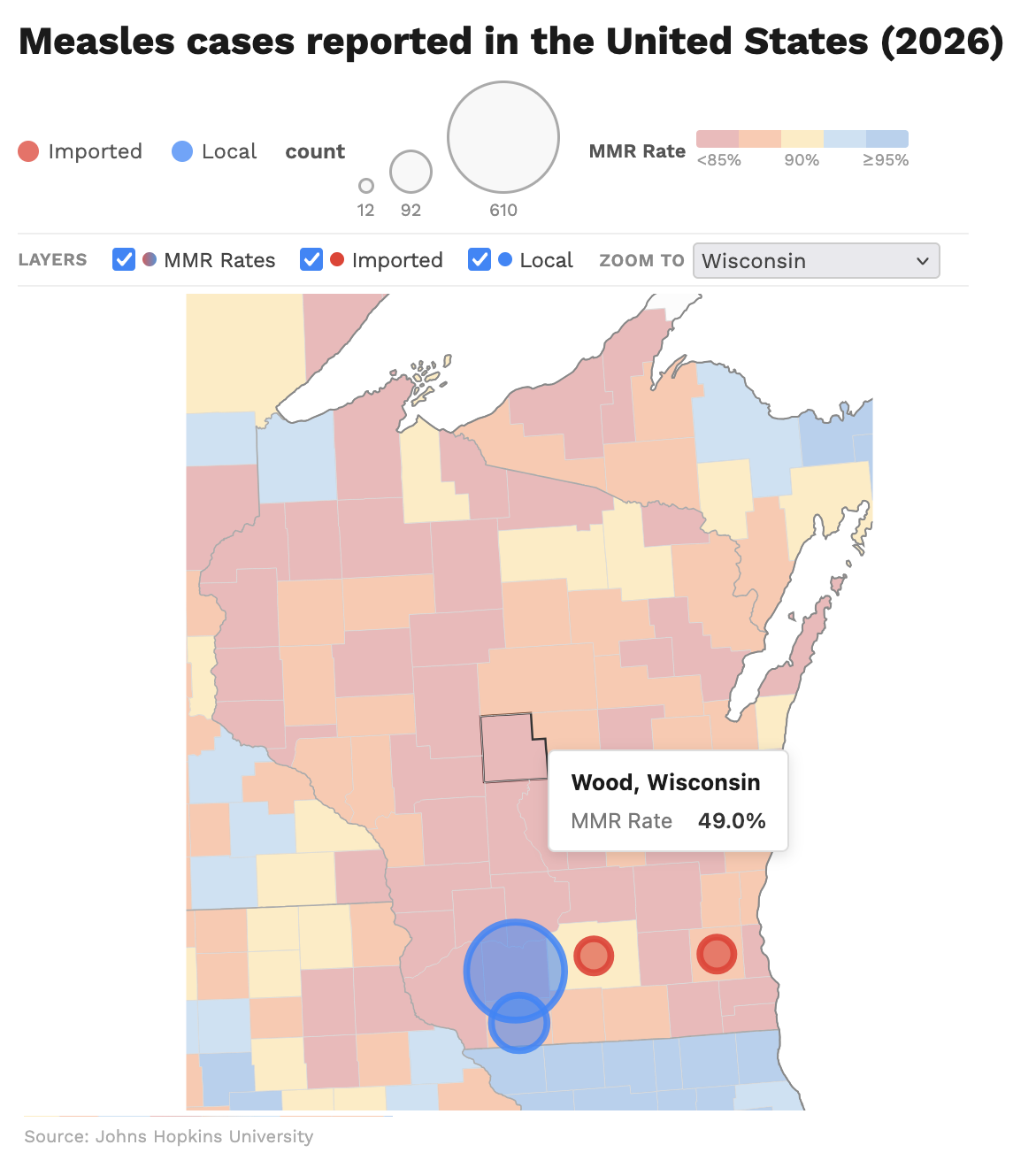
Wisconsin - nearly all counties in Wisconsin have MMR vaccination rates below 95% and some are below 50%! And there is not much to keep a measles outbreak that has started in southern Wisconsin from spreading to other counties, many of which have large populations of poorly vaccinated Amish communities.
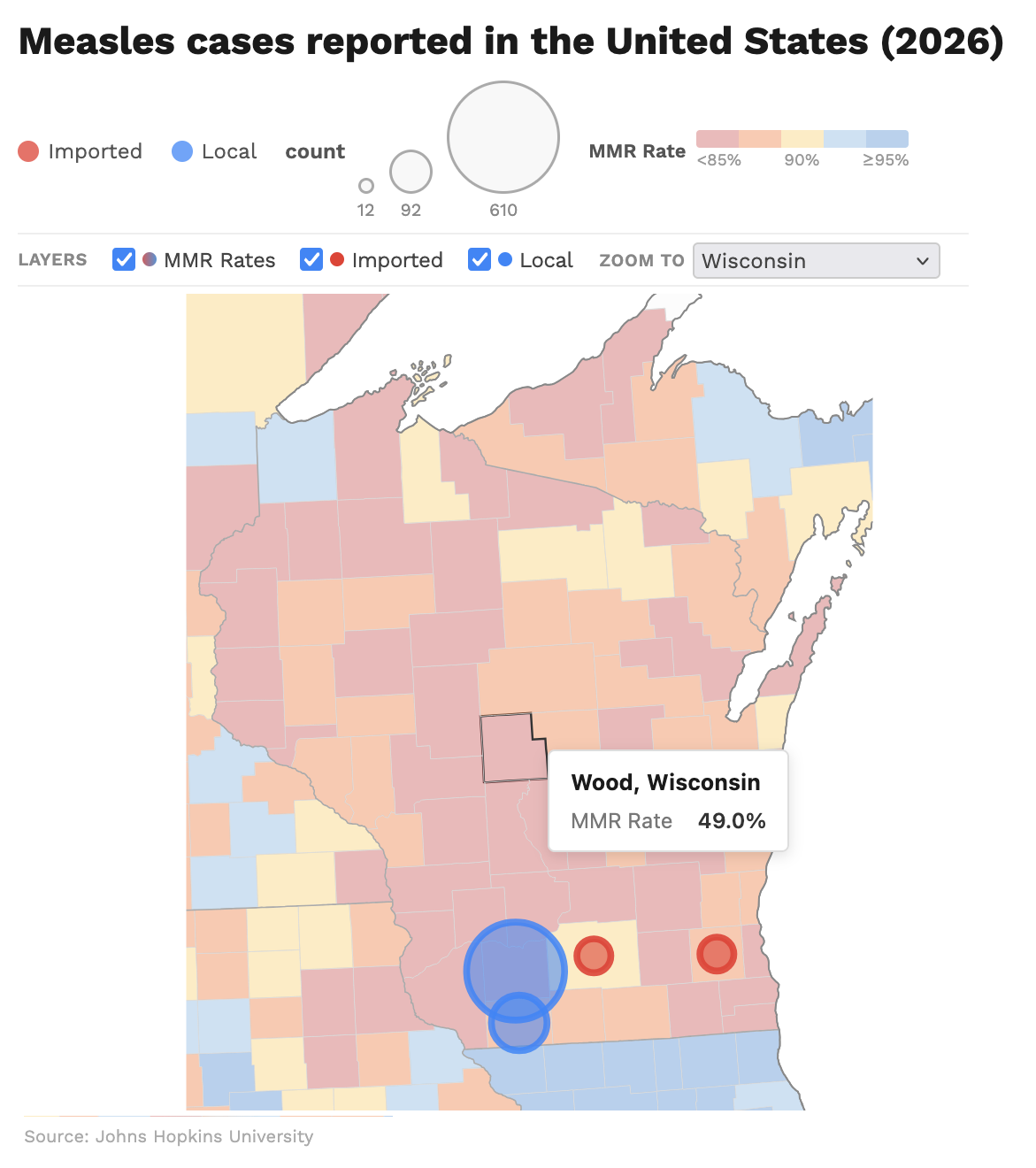
More measles cases are coming to Wisconsin! Minnesota - many communities - Amish communities - in central and south-eastern Minnesota have low immunization rates and are at risk for more measles cases this year.
Idaho - several counties have MMR immunization rates at or below 50%! Watch for outbreaks in Treasure Valley area of southwestern, Idaho, Kootenai–Bonner–Boundary Counties of northern Idaho, Twin Falls, and eastern Idaho.
Iowa - has low statewide average MMR rates, plus Amish and Mennonite communities with even lower rates. An outbreak that has already started has plenty of fuel to grow.
Colorado - at high risk for a large outbreak, with many counties below 80% MMR vaccination rates. The Colorado Springs–El Paso–Teller–Elbert area is at especially high risk with its low immunization rates, high population, and the fact that it is surrounded by counties with even lower immunization rates.
Missouri - numerous counties have dramatically low MMR vaccination rates, like Douglas, Cedar and Daviess County at 60 to 70%. At especially high risk are the Seymour–Webster–Douglas–Wright County area and the Jamesport—Daviess, Grundy and Livingston County areas.
Kansas - has extremely low county level immunization rates, plus large Amish and Mennonite communities = at risk for large measles outbreaks.
Oregon - there is a high risk for outbreaks in the Portland metro area, Marion–Polk, Linn, and Klamath Counties, and southern Oregon.
Washington - there is a high risk for outbreaks in Clark, Snohomish, Stevens, Spokane, and Kittitas Counties.
Michigan - the Osceola, Clare, Gladwin, and Montcalm area are likely most at risk for a big outbreak, followed by Grand Traverse County.
Florida - overall MMR vaccination rates are below 90% and even worse in some places, like the Sarasota–Manatee–Tampa Bay corridor, a large metropolitan county with MMR rates at only 82%
Montana - overall low MMR vaccination rates at about 86% plus a risk of transmission from neighboring regions. Most at risk are the Gallatin County/Bozeman, Lewis and Clark County/Helena, Flathead County/Kalispell, Yellowstone County/Billings and Hill, Blaine and Cascade counties.
Kentucky - already has an expanding outbreak. The highest risk areas include Christian, Trigg, Todd, and Caldwell counties in southwestern Kentucky, and Washington county, and of course, the Amish, Mennonite and other conservative religious communities in Kentucky.
North Dakota and South Dakota - both are at high risk for a large outbreak, especially the Pembina–Grand Forks–Traill–Cass area of North Dakota and in South Dakota, Grant–Brookings–Codington, Edmunds and surrounding north-central counties, and Rapid City/Pennington–Meade counties.
Oklahoma - has high exemption rates, but may be saved from a big outbreak by smaller pockets of susceptibles.
Nevada - has some pockets of low coverage, but mostly in areas of low population.
Arkansas - with an MMR vaccination rate of 91.5%, they are less at risk than most states for a large outbreak, but still at moderate risk for a smaller outbreak.
Don’t be fooled though.
It isn’t only Amish and Mennonite communities that are going to be hit with measles outbreaks.
They are simply going to be hit first, it seems, as they have very large numbers of people grouped together with very low vaccination rates and the herd immunity levels of protection around them that were keeping them safe have collapsed.
Next, as it becomes more evident that measles has once again become endemic, all of the other free-riders will start getting sick too.
As will most other states that weren’t listed above…
Bottom line - more measles and more deaths are coming. Get vaccinated and protected.
More on Measles Outbreaks
Trends in County-Level MMR Vaccination Coverage in Children in the United States
Risk of Measles Outbreak in Texas School Districts: A Modeling Study
Assessing MMR vaccination coverage gaps in US children with digital participatory surveillance
New US map of MMR vaccine uptake reveals considerable gaps, potential for more measles
There is another factor to consider, areas where anti-vax MDs are actively spreading misinformation. There is a group on Maui for example that brings out a cadre of antivaxers on a regular basis for community presentations. I attended one such meeting. Speakers included Malone, Milhoan, Cole among others. Texas is very susceptible to misinfrmation from Dr. Peter McCullough as is Wisconsn with infuence from Dr. Kory. The point is don't understimate the impact that anti-vax inlfuencers can have locally and regionally. Wherever they go, disease follows.