

Why do some people think that an MIT vaccine safety study was too risky to be published for peer review?
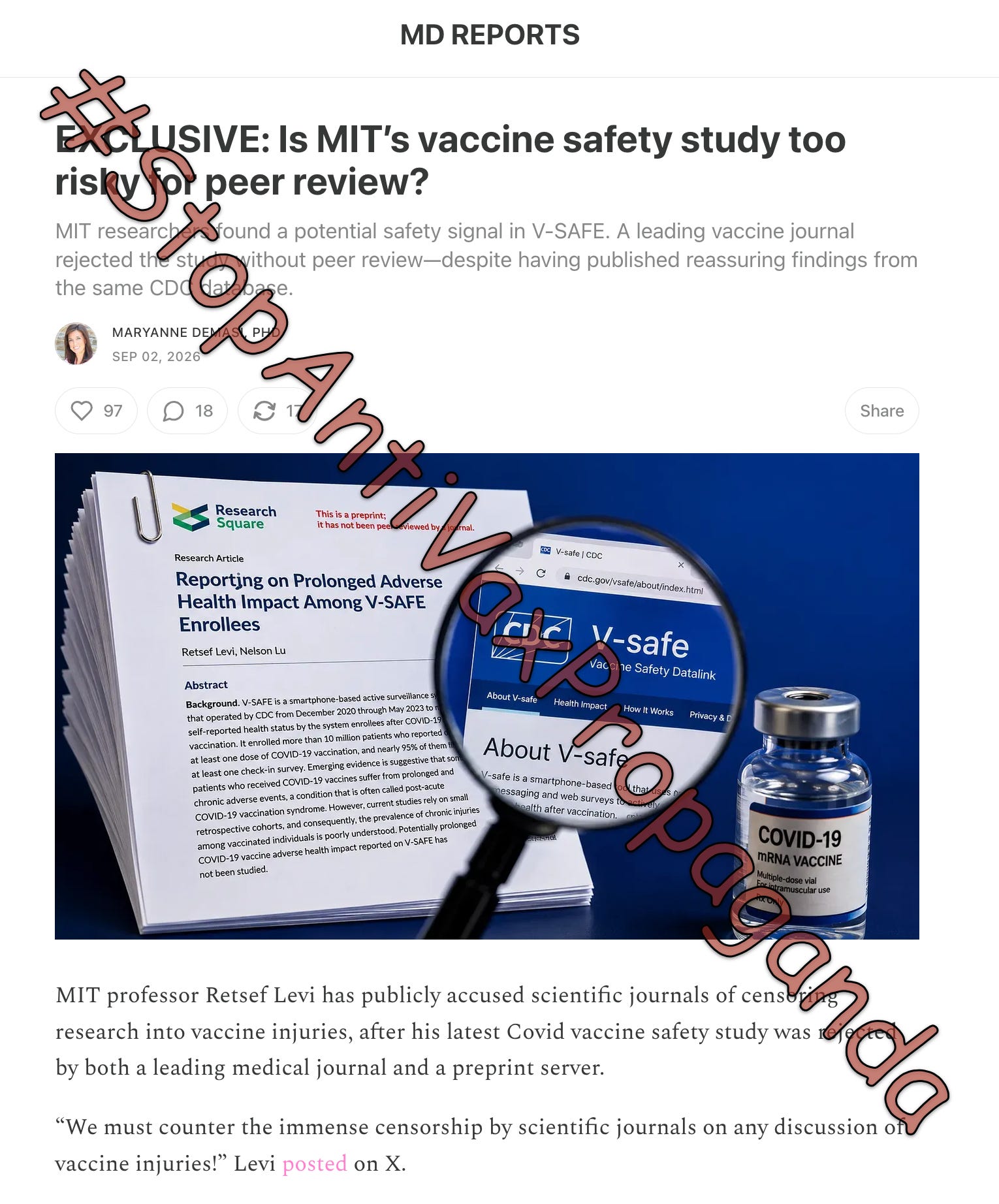
The usual suspects…
Was an MIT Vaccine Safety Study Too Risky for Peer Review?
In this case, the usual suspects are Maryanne Demasi and Retsef Levi.
And as usual, there is a lot going on here…
Firstly, the paper in question was not an MIT vaccine safety study!
It was a non-peer-reviewed preprint published by Retsef Levi (Professor of Management and Operations Management at MIT) and Nelsun Lu (a student at MIT studying business analytics).
So, while it was a study by MIT researchers working outside their field of expertise, MIT had no institutional role in getting it published or in the design of the study, so it was not an MIT vaccine safety study.
Still, why did a leading medical journal reject the study preprint without peer-review?
Could it be that Retsef Levi submitted a non-peer-reviewed preprint for publication?
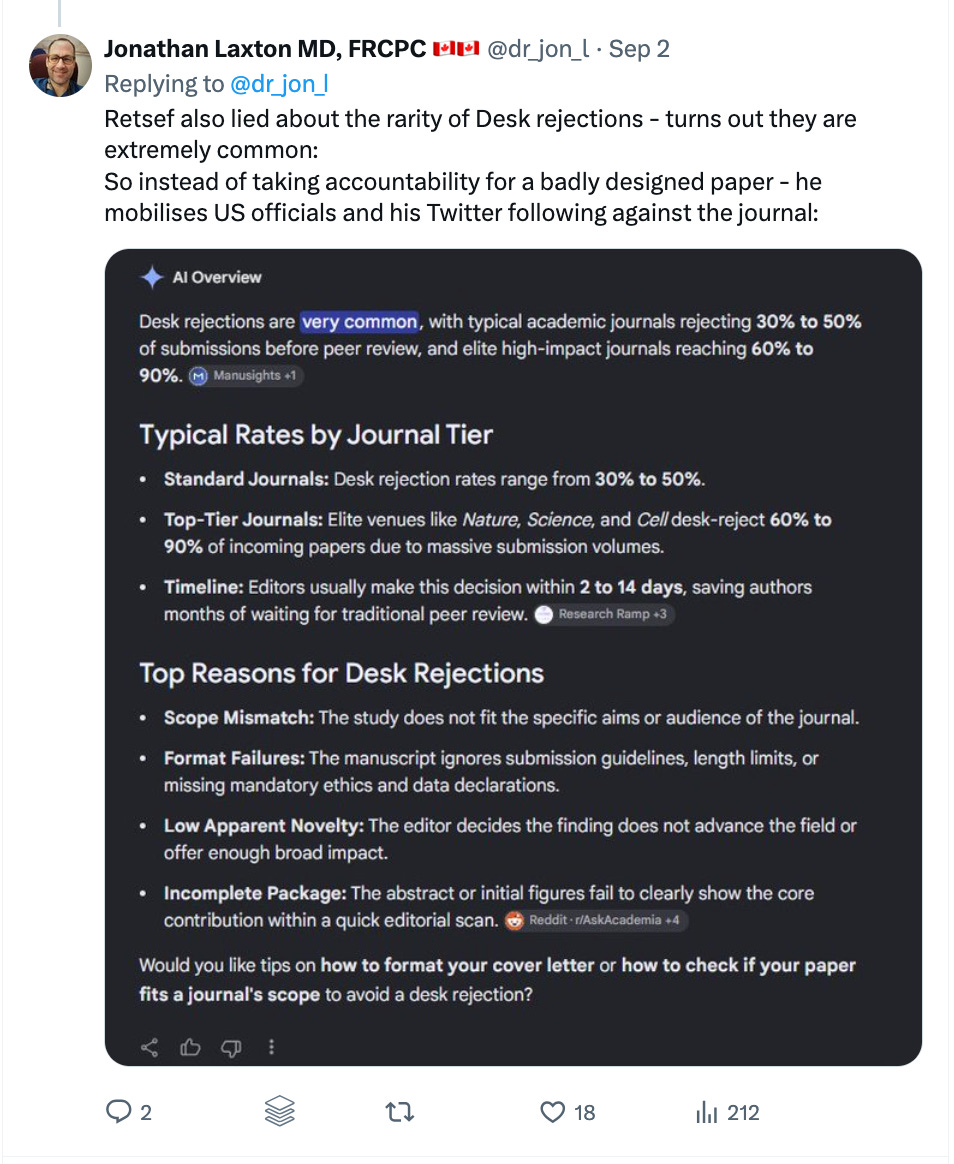
And instead of censorship, we are simply seeing the rejection of a poorly done paper by someone who seems to have a clear anti-vaccine agenda. After all, this is the guy who coauthored another preprint with Joseph Lapado suggesting that COVID vaccines increased mortality rates.
“This raises the concern that perceived chronic COVID-19 vaccine injuries may be more prevalent than previously thought.”
Reporting on Prolonged Adverse Health Impact Among V-SAFE Enrollees
And this is a poorly done paper that basically looked at V-safe data for people who reported a prolonged problem and whose free-text response indicated that they thought vaccination caused it.
Can you see one of the problems already?
The v-safe surveys were not designed to assess how long symptoms lasted in the free-text response field. So a symptom reported at three months does not necessarily mean that symptom lasted for three months.
And just because someone self-attributed their persistent problems to a vaccination doesn’t, of course, mean that a vaccine caused the problem. After all, Retsef Levi had no unvaccinated control group in his study!
Still, isn’t it important to know if people had persistent symptoms after getting their COVID vaccines?
Sure, it is important data to look for as signals that might indicate a problem.
It’s not as useful when you are actually looking for evidence that a vaccine is causing those prolonged problems.
It’s especially not so useful when other, better-published, peer-reviewed studies have been done looking for safety issues, including some that analyzed free-text responses:
Preliminary Findings of mRNA Covid-19 Vaccine Safety in Pregnant Persons
COVID-19 Vaccine Safety in Children Aged 5–11 Years — United States, November 3–December 19, 2021
What else?
Retsef Levi’s own study found that an even larger group of people had prolonged worsening, but they did not attribute it to receiving a vaccine!
Lastly, several studies have been done that found few people having persistent symptoms after receiving COVID vaccines.
They found no evidence to support the claims in Retsef Levi’s non-peer-reviewed preprint.