


Why are we talking about vaccine clinical trials yet again?
The usual suspects…
Let’s Talk About Vaccine Clinical Trials Yet Again
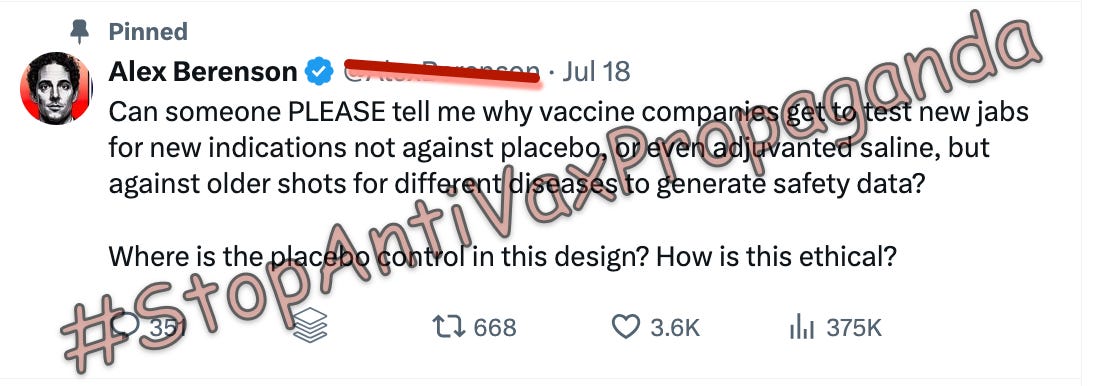
Apparently, Alex Berenson has decided to write about vaccine clinical trials, and in doing so, he reveals yet another of his blind spots.
That’s right, Alex Berenson knows as much about placebos and vaccine clinical trials as he knows about COVID!
Let’s see what Alex Berenson is saying about the ‘loophole’ in vaccine clinical trials…
that you can’t use a vaccine as a placebo control - of course you can!
that instead of saline, we use control vaccines because they are more likely to cause side effects and maintain blinding of the study - this is silly. A control vaccine is used because it is unethical to use a saline placebo when an “efficacious and safe vaccine exists” that can be used as a placebo control vaccine.
that vaccines are tested using control vaccines for unrelated diseases - control vaccines are typically for a related or similar disease, like in the Prevnar clinical trials, in which the control vaccine was another meningitis vaccine.
that vaccines are held to lower standards than drugs and other medicines - not true at all.
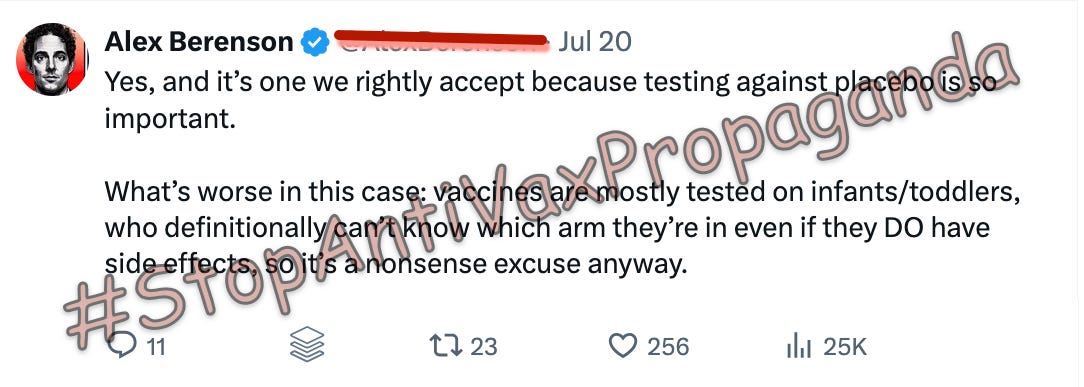
that it is insane to think that it is important to want your vaccine clinical trial to be blinded - Berenson goes so far as to think it doesn’t matter if a clinical trial is blinded when infants or toddlers get a vaccine because they won’t know if it is a vaccine or a placebo, not understanding that blinding is also for the person giving the shot, the person recording the side effects, and the parent of the child, etc.!
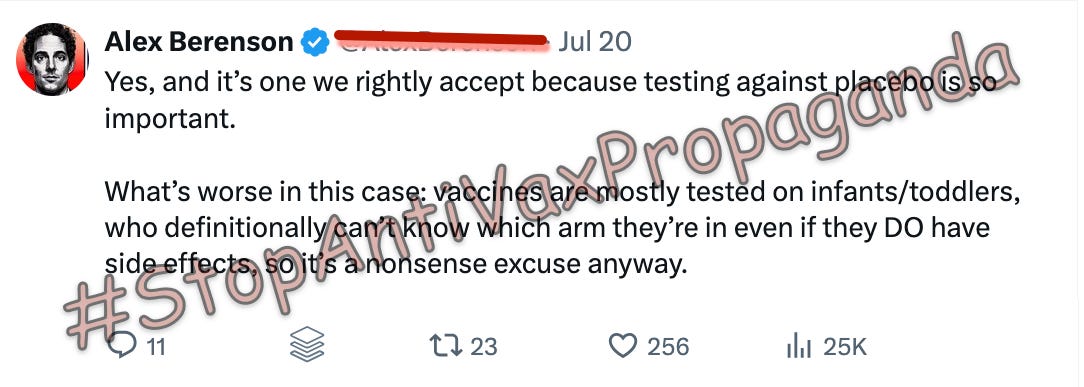
Alex Berenson doesn’t seem to understand that if a clinical trial isn’t properly blinded, then bias can ruin the trial, as folks might know who got a study vaccine and who got a control vaccine.
What’s his example?
The original Prevnar vaccine, PCV7, which he claims used a “sleight-of-hand” to get approved because, to give the control group some benefit, they used an investigational meningitis vaccine as the control vaccine in a clinical trial.
It didn’t use a saline placebo, but it didn’t have to.
“Placebo Control – A comparator in a vaccine trial that does not include the antigen under study. In studies of monovalent vaccines this may be an inert placebo (e.g. saline solution or the vehicle of the vaccine), or an antigenically different vaccine. In combined vaccines, this may be a control arm in which the component of the vaccine being studied is lacking.”
WHO on the Guidelines on clinical evaluation of vaccines: regulatory expectations
Do you see the problem with the thinking of Alex Berenson?
Prevnar is also a meningitis vaccine, which is in line with the protocols for choosing a control vaccine.
And while it was an investigational vaccine, it too was approved a few years later in most countries, so it was already well studied.
And then there is the simple fact that some people in the clinical trials that were used for the approval of Prevnar didn’t even get a control vaccine!
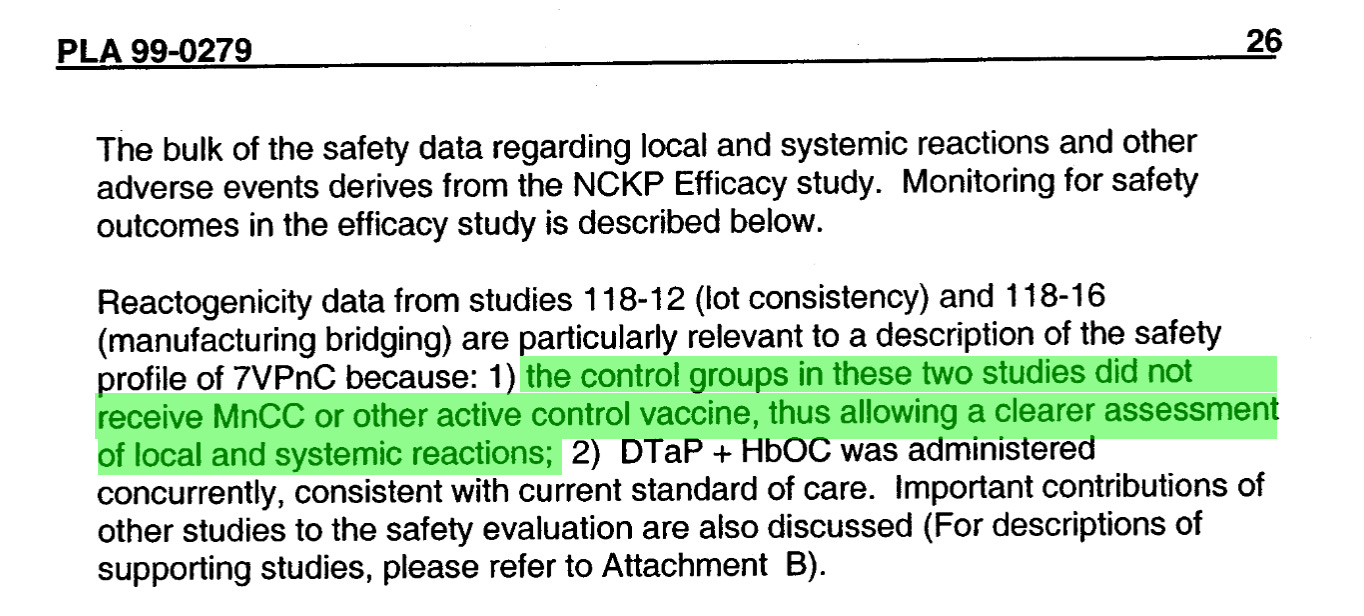
Most importantly though, the clinical trials for Prevnar were thorough.
“All subjects in the NCKP efficacy trial were followed for specified adverse events. Hospitalizations within 60 days of study vaccines, emergency room visits within 30 days, and outpatient clinic visits within 30 days of each vaccine dose were recorded. Rates of outpatient clinic visits for diagnoses of interest (i.e. seizures, allergic reactions, including hives, wheezing, shortness of breath and asthma) were also assessed and provided in the PLA.”
Summary For Basis of Approval
At the time, it was probably the most comprehensive study ever done, as it used the Northern California Kaiser database to track anything and everything that happened to patients after they received their vaccines!

So know that Prevnar was approved because it worked and it was a safe vaccine.
“The comparative SIDS data are reassuring with respect to the safety of Prevnar, as rates of SIDS observed among Prevnar recipients in the efficacy trial were less than the rate observed in the MnCC group, and less than comparative data for the state of California over a two-year period.”
Pneumococcal 7-valent Conjugate Vaccine (Diphtheria CRM197 Protein) Clinical Review - Prevnar
Also, it was safely given to nearly 40 million children before it was replaced by a newer version - Prevnar 13.
Postlicensure surveillance for pneumococcal invasive disease after use of heptavalent pneumococcal conjugate vaccine in Northern California Kaiser Permanente - found “a remarkable decline in and virtual absence of invasive pneumococcal disease among young children in a large, defined United States population after vaccination with a heptavalent pneumococcal conjugate vaccine.”
Postlicensure safety surveillance for 7-valent pneumococcal conjugate vaccine - most reports of side effects were generally minor adverse events previously identified in clinical trials.
Something that was confirmed in all of the post-vaccine monitoring studies!
And that’s an important point.
If anti-vaccine influencers are correct that vaccines are being approved with inappropriate clinical trials, then why isn’t this quickly uncovered when post-vaccine monitoring studies are done?
“Vaccine trials often use a different, lower standard that makes it impossible to tell how serious their side effects are. The loophole is especially bizarre because most vaccines are not given to sick people who need immediate help but prophylactically to healthy children.”
Alex Berenson
Also, if vaccine clinical trials use a loophole to get vaccines approved and have such low standards, then why aren’t all vaccines approved?
Why were these vaccines never approved because of safety issues uncovered in their clinical trials?
Formalin-inactivated RSV vaccine, “Lot 100” - led to more severe RSV disease in those who were vaccinated (1966)
High titer measles vaccine - led to higher mortality in those who were vaccinated (early 1990s)
AN1792 Alzheimer’s therapeutic vaccine - 6% of treated participants developed meningoencephalitis (2002)
Merck MRKAd5 HIV vaccine - led to an increased rate of HIV acquisition in some vaccinated men (2007)
Merck V710 Staphylococcus aureus vaccine - higher mortality and multiorgan failure in those who got the vaccine vs placebo (2011)
And of course, many other vaccines in development never made it to the approval phase because their clinical trials uncovered that they didn’t work well enough.
If clinical trials are “fixed,” wouldn’t they all have been approved anyway?
“Calls or policies requiring the use of placebos to test vaccines are ethically flawed and unsound in their insistence that this is the only method for generating credible or so-called ‘gold standard’ science.”
Fool’s-gold science : The ethical and scientific perils of testing most vaccines using placebo-controlled randomized trials
Lastly, know that even if every vaccine on the childhood schedule had new double-blind, placebo (saline) controlled, randomized clinical trials, that still wouldn’t convince anti-vaccine influencers that vaccines were safe. They would just move the goalposts and complain about something else…
More on Vaccine Clinical Trials
Where are the Double Blind Placebo Controlled Randomized Trials about Vaccines
Placebo use in vaccine trials: Recommendations of a WHO expert panel
Technically Speaking: 75 Years of Placebo-Controlled Vaccine Testing in the U.S.
Pneumococcal 7-valent Conjugate Vaccine (Diphtheria CRM197 Protein) Clinical Review - Prevnar
Randomized Clinical Trials for Vaccine Safety, Efficacy and Effectiveness
Alex Berenson misrepresents data on death rates by vaccination status in England