


Anti-vaccine influencers still don’t understand why more children and adults have been getting diagnosed with autism in recent years.
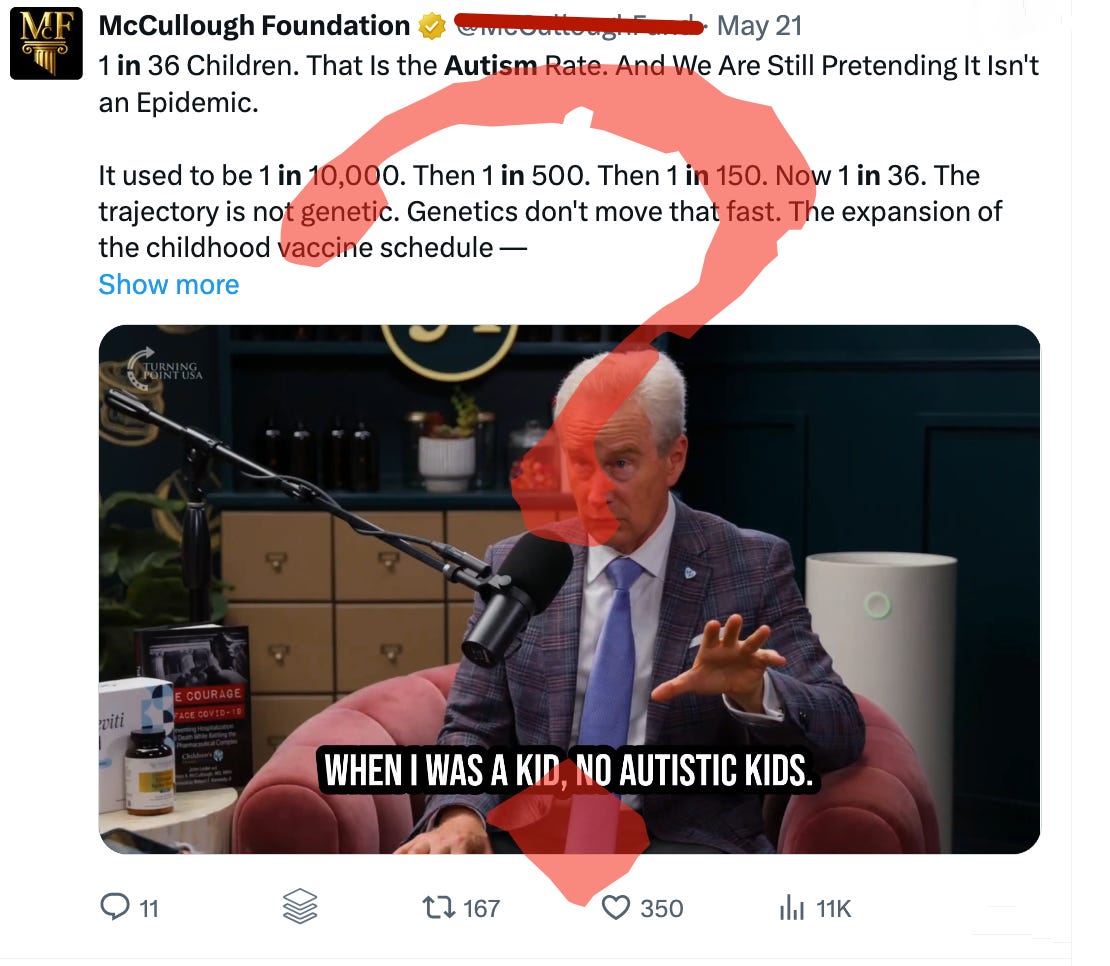
Instead, they continue to focus on vaccines as the main cause for some kind of autism epidemic.
Would Your Child Have Been Diagnosed With Autism When Peter McCullough Was a Kid?
And they ignore the simple fact that changes to the diagnostic criteria have had a big impact on more children and adults getting diagnosed with autism.
For example, while Peter McCullough claims that when he was a kid, there were “no autistic kids,” that is of course not true.
Sure, he likely didn’t see any autistic kids, but that doesn’t mean they didn’t exist.
At the time:
laws had not yet been passed to stop schools from excluding children with disabilities. Laws like the Education for All Handicapped Children Act in 1975 the IDEA, in 1990, and the IDEA amendments of 1997, which finally helped get autistic kids into school.
since they weren’t allowed in school, autistic children were hidden away at home or sent away to state institutions
many were undiagnosed, as the criteria to diagnosis autism at the time was very strict, only including kids who were diagnosed with schizophrenia before puberty! These children with schizophrenia, childhood type, would have “autistic, atypical, and withdrawn behavior; failure to develop identity separate from
the mother’s; and general unevenness, gross immaturity and inadequacy in development. These developmental defects may result in mental retardation, which should also be diagnosed.” That would, of course, leave out many autistic children and adults who would have been diagnosed by modern criteria.
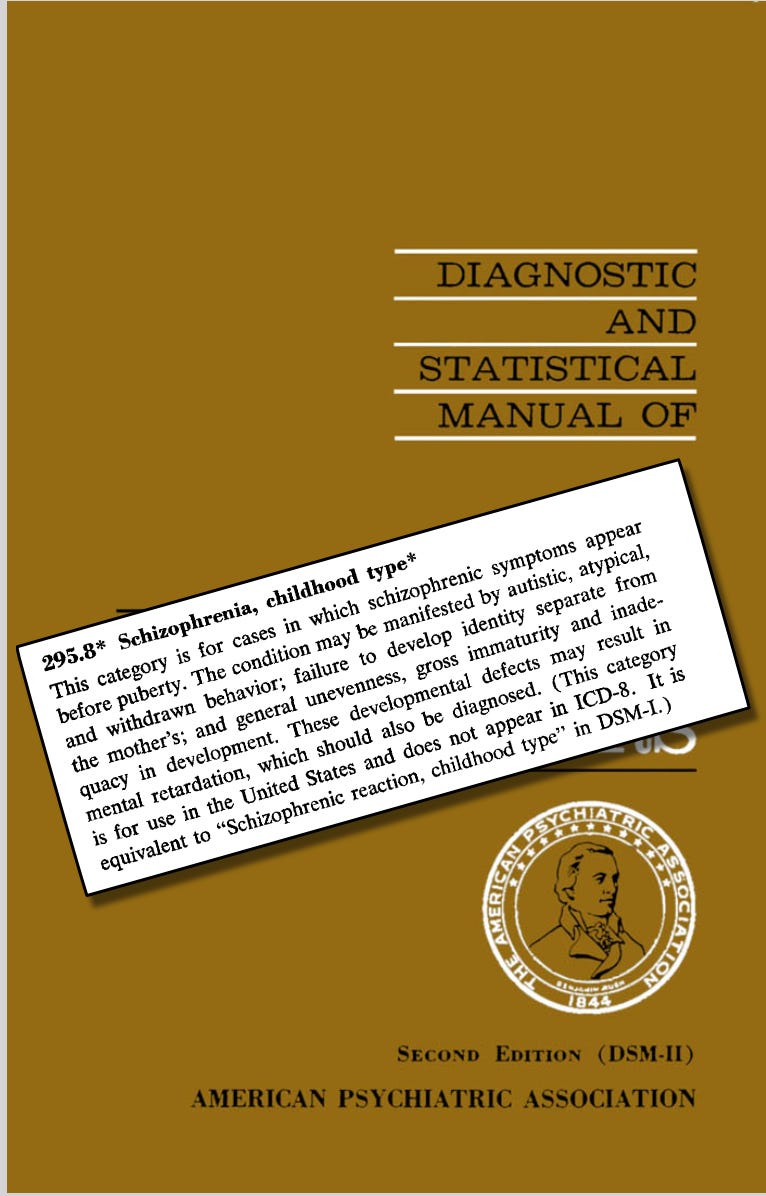
Autism wasn’t added as a separate category, infantile autism, with expanded criteria, until DSM-III (1980) and then autistic disorder, in DSM-IIIR (1987), and once again (added Aspergers, etc.) in DSM-IV (1990) and DSM-V (2013). there was little awareness of autism and minimal screening for autism at the time
Are you starting to understand now why folks like Peter McCullough, Del Bigtree, and RFK Jr might believe that there were no autistic kids around when they were kids?
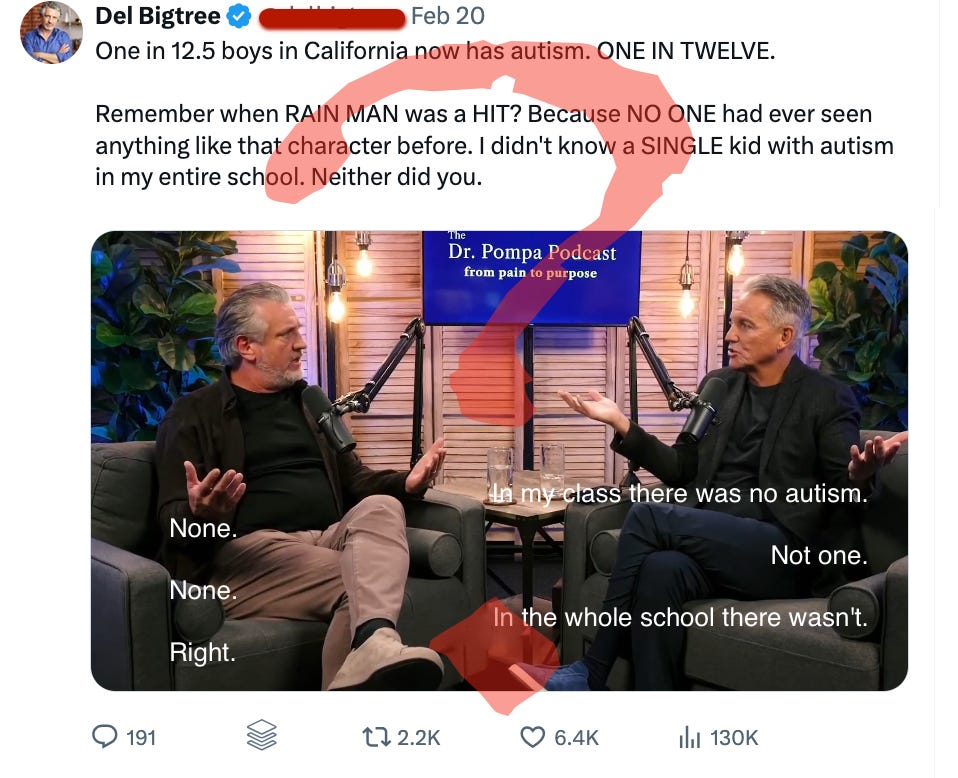
And why the rise in autism has been driven, not by vaccines, but by broadening of the criteria to diagnose autism (DSM changes), diagnostic substitution (children who used to be diagnosed with mental retardation and learning differences are now diagnosed with autism), better recognition with increased awareness, more screening, and social influences, especially that children with disabilities are no longer excluded from school.
Just like has happened in other countries!
“THE number of individuals registered with autism under Malaysia’s Social Welfare Department (JKM) has increased eightfold over the past decade, reflecting what authorities describe as growing public awareness and stronger support systems for children with autism spectrum disorder.”
Autism registrations surge eightfold as awareness and support services expand
In Malaysia, for example, they have seen a 700% increase in kids being diagnosed with autism in the past 10 years, even though there have been no changes to immunization rates or to their childhood immunization schedule since Hib was added in 2002.
Why Rising Autism Rates Are a Good Thing
And hopefully you understand that the surge in kids being diagnosed in Malaysia and other countries is a good thing!
She pointed out that part of the increase was due to better awareness and diagnosis, which was good progress. “But some parents still delay diagnosis, hoping their child will “grow out of it,” or because of cultural beliefs or social pressure,” she added.
Nearly 60,000 children with autism registered in Malaysia, says Alice Lau
After all, it doesn’t really mean that there are more autistic children, but simply that more of them are finally getting diagnosed.
Something that we need to help spread to every community in every country, especially in those where there is still a lot of stigma around autism and where kids are less likely to get diagnosed or helped.
What Low Autism Rates Mean…
Contributing to the continued stigma is a lack of updated training among health care providers in some countries.
In France, for example, many experts report that only about 15% of autistic children and adults in get diagnosed!
“Many French autists are confined to day hospitals and live-in institutions, isolated from the community and frequently unable to communicate through speech—whereas in the US, for example, public schools are required by law to fully include autistic children in mainstream classroom education.”
France has an autism problem
It’s no surprise that they, like many other European countries, have some of the lowest rates of autism in the world.
Do you see how that works?
Low autism rates mean that a community or country simply isn’t looking to diagnose anyone with autism! Or they don’t have the resources to diagnose anyone with autism.
In many countries, in addition to poor resources, there is a lack of awareness about autism and a stigma to getting diagnosed.
“Services for children with autism in Ethiopia are extremely limited; appropriate care for these children is further impeded by stigma and lack of awareness.”
Challenges and opportunities to improve autism services in low-income countries: lessons from a situational analysis in Ethiopia
As you might expect, this causes confusion for these families if they come to the United States and their children are diagnosed with autism, something they didn’t even know existed in their home country. But of course, it did exist - it just wasn’t ever diagnosed!
Bottom line - anti-vaccine influencers do much harm by continuing to push the idea of an autism epidemic that is associated with vaccines.
My daughter, born in 2003, did not get diagnosed with moderate autism until 2015. Her psychologist thought she was autistic in 2013 but it was neuropsych who formally diagnosed her in 2015. All her “quirks” and communication issues made sense after that diagnosis! They weren’t ignored proir to 2013. It was just that she was a girl and she was quiet and her stemming was gentle and her need to get away from society. Every afternoon was quiet. She did not present like the stereotypical autistic boy. She had speech issues and she went to speech therapy as a toddler, but then she got over them.