
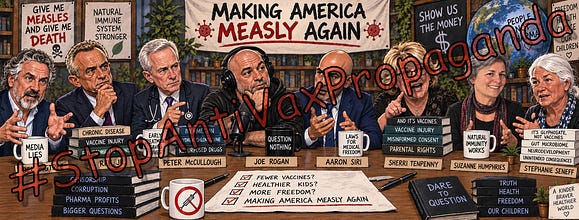

Can you guess why anti-vaccine influencers are so obsessed with the movie Rain Man?
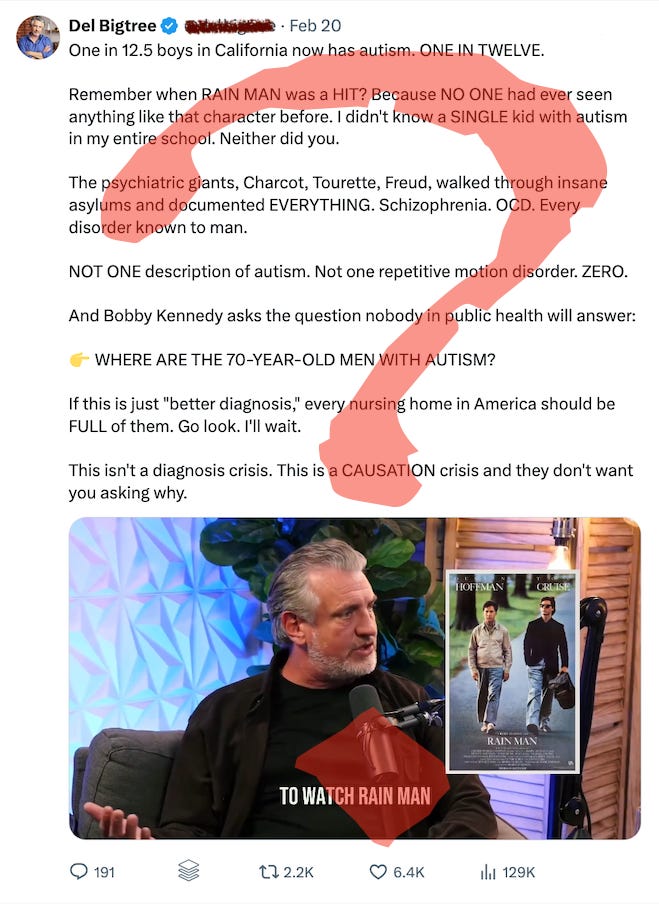
It is because it goes along with their narrative that autism didn’t really exist before the 1980s…
Why Are Anti-Vaccine Influencers Obsessed With the Movie Rain Man?
And why is that important to them?
“In 1965, my father toured Willowbrook on Staten Island and launched the national campaign to shut down these medieval warehouses for human beings. I worked for 200 hours in one of those nightmare facilities—Wassaic Home for the Retarded in Dutchess County, New York in 1968 and 1969. I worked around people suffering every kind of intellectual disability, Down syndrome, cerebral palsy, schizophrenia and hydrocephaly, among many others. I never saw a case of autism. In fact, like most Americans, I knew nothing about the disease until I saw the extremely mild form depicted by Dustin Hoffman in the film Rainman [sic] in 1988.”
RFK Jr - Is the Autism Epidemic Real?
It is because it goes with their other narrative that rates of autism increased as new vaccines were added to the immunization schedule with the passage of the National Childhood Vaccine Injury Act of 1986.
Of course, there are plenty of other reasons for why we have been diagnosing more kids with autism that they completely ignore.
But what about the movie Rain Man…
Although Rain Man came out in 1988, it is important to note that:
work on the screenplay for Rain Man began in 1984
the person who was the inspiration for the movie, Kim Peek, was a 34-year-old savant who was diagnosed with autism as a child - he was born in 1951
the screenwriter, Barry Morrow, met Kim Peek at a disabilities’ convention in Arlington, Texas
So there is clearly no connection to the National Childhood Vaccine Injury Act of 1986.
And Rain Man wasn’t even the first movie centered on an autistic character.
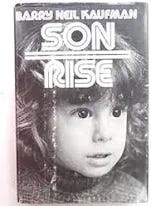
Son-Rise: A Miracle of Love was a 1979 movie, based on a 1976 book, that told the true story of a family’s effort to treat their child at home, even as they were told they should institutionalize him.
“In 1978, Noah Greenfield was 12. He could not speak and had been diagnosed as brain-damaged and autistic. His father, Josh Greenfeld, wrote several candid books about life with his son. At that time, many children like Noah were institutionalized. But the Greenfields wanted to raise him at home. Was this a mistake? Perhaps.”
Noah’s Story: 60 Minutes Classic
There is also the book, A Child Called Noah, that was published in 1972.
Where Are the Adults With Autism?
To go along with their propaganda that vaccines cause autism in the past few decades, anti-vaccine influencers like to push the idea that there are no adults with autism.
“WHERE ARE THE 70-YEAR-OLD MEN WITH AUTISM?
If this is just "better diagnosis," every nursing home in America should be FULL of them. Go look. I'll wait.”
Del Bigtree
Of course, this ignores the fact that there are many adults with autism!
“Where are all the adults with classic autism? Where are the hand flapping, head banging, self-abusive, spinning, screaming, rocking, stimming, non-verbal and violent 40, 50, 60, 70, 80 and 90 year olds wearing autism helmets and diapers? Where are the grown-ups at the mall experiencing violent tantrums, seizures and GI tract problems?”
RFK Jr - Is the Autism Epidemic Real?
Sure, some are just getting diagnosed now, as there was less autism awareness when they were younger, but it is still easy to find autistic adults if you look.
Most won’t look like RFK Jr.’s ableist way of describing them, of course, but there are many autistic adults.
“Secretary Kennedy’s rhetoric about autism distorts public understanding and undermines respect for autistic people.”
AUCD Statement: RFK Jr. Hearings
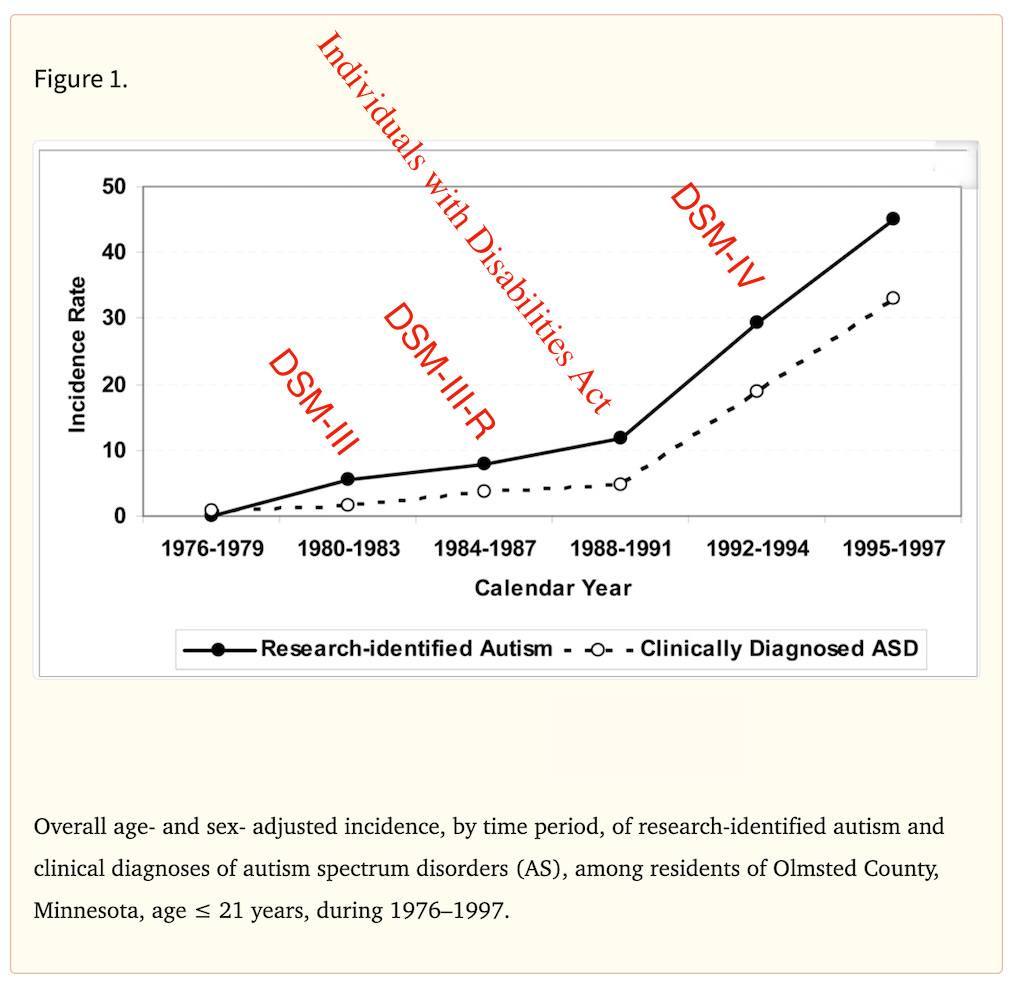
It is even likely that there are many adults who might be autistic, including those in nursing homes, who might not know it! After all, before the DSM-III changes in 1980, only those people who were diagnosed with childhood schizophrenic reaction met Kanner’s original criteria for autism.
Their diagnosis would likely have been missed when they were growing up.
“Increasingly adults over the age of 50 are receiving a diagnosis of autism spectrum condition. Growing up in a time when autism was poorly recognised, these adults have lived unknowingly with the condition and face readjustment.”
Living with autism without knowing: receiving a diagnosis in later life
But they are starting to get diagnosed when they are older, a diagnosis that is life-changing for many of them!
“Receiving first-time diagnosis of autism spectrum conditions in adulthood is important clinically (eg, to help access services), psychologically, and socially. The diagnosis can be a relief because it provides a framework through which to explain longstanding interpersonal, social, and sensory-perceptual difficulties and make sense of feelings of difference or being on the margins. Additionally, diagnosis can help with self- acceptance, which can be empowering, and might also facilitate identity formation, which helps individuals to embrace their strengths and difficulties as parts of the self rather than being attributed to a disease that needs to be cured or eradicated.”
Identifying the lost generation of adults with autism spectrum conditions
But you won’t hear about any of this from folks like Del Bigtree or RFK Jr…
“With improved awareness that autism spectrum conditions in adulthood might have been missed owing to previous diagnostic restrictions, increasing numbers of adults are now receiving appropriate and timely diagnoses.”
Identifying the lost generation of adults with autism spectrum conditions
They don’t want you to know that middle-aged and older autistic adults are undiagnosed, a “lost-generation” that have not been getting the help they need.
They continue to push the narrative of an autism epidemic to scare parents away from vaccinating their kids, a narrative that is vanishing as we finally find more and more autistic adults.
Autistic adults that Del Bigtree and RFK Jr have long said don’t exist.
More on Adults with Autism
If It’s Vaccines, Then Why Are There Autistic Kids Who Are Unvaccinated?
Stephanie Seneff’s Prediction: Half of Kids Autistic by 2025?
Getting Diagnosed With Autism As an Older Teen Or Young Adult
DREDF Denounces RFK Jr.’s Comments on Autism as Hateful, Harmful and Uninformed
Living with autism without knowing: receiving a diagnosis in later life
Older Age Autism Research: A Rapidly Growing Field, but Still a Long Way to Go
Identifying the lost generation of adults with autism spectrum conditions
Around 90% of middle-aged and older autistic adults are undiagnosed in the UK, new review finds
National and State Estimates of Adults with Autism Spectrum Disorder
What does receiving autism diagnosis in adulthood look like? Stakeholders’ experiences and inputs