


Can you guess when we stopped using iron lungs to treat people with polio?
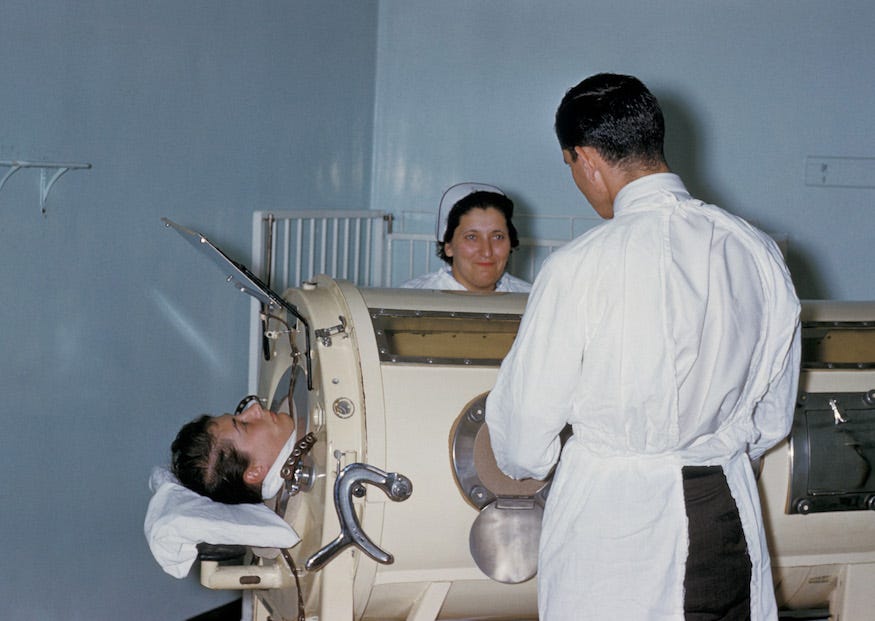
I’ll give you a hint, the answer has nothing to do with vaccines and the elimination of endemic polio in the United States in 1979.
When Did We Stop Using Iron Lungs for Polio?
Need another hint?
Even though there haven’t been new cases of polio in the United States in many years, there were many people who got sick with polio before we had a polio vaccine.
And some of those polio survivors preferred to use an iron lung even after they had other options, specifically modern positive pressure ventilators.
Remember Paul Alexander?
“Polio struck Paul Alexander in 1952, when he was just 6 years old. Within days, the disease robbed him of the use of his body. But he fought through the illness, using an iron lung for more than 70 years — and inspiring people with his determination to live a full life. He painted, wrote a book and worked for years as an attorney.”
Paul Alexander, forced into an iron lung by polio in 1952, dies at 78
He used an iron lung for nearly 70 years - until he died at age 78 in Dallas, Texas in 2024.
Similarly, other polio survivors who had been using an iron lung and who died recently include:
Martha Mason - got sick with polio in 1948 in Cleveland County, North Carolina on the same day her older brother was being buried - because he had been sick with polio. She survived as a quadriplegic dependent on her iron lung. She died in 2009.
June Middleton - she spent 16 hours a day in her iron lung, having gotten sick with polio when she was 22 years old in Australia. She died in 2009 at the age of 83.
Dianne Odell - she started using an iron lung when she got sick with polio when she was 3 years old, in 1950. She died in 2008 during a power failure in Tennessee, after a backup emergency generator which would have kept her iron going didn’t start.
Mona Randolph - she contracted polio in 1956, when she was 20 years old. She died in 2019.
And they were all horrified at the idea that polio could come back!
Alexander said, “Now, my worst thought is that polio’s come back.” He added, “If there’s so many people who’ve not been—children, especially—have not been vaccinated... I don’t even want to think about it.”
Lillard separately said, “I would just do anything to prevent somebody from having to go through what I have.”
Similarly, Randolph said, “When children inquire what happened to me, I tell them the nerve wires that tell my muscles what to do were damaged by a virus. And ask them if they have had their vaccine to prevent this. No one has ever argued with me.
Inside the lives of America’s last iron lung patients
Similarly, Martha Lillard had spent most of her life in an iron lung.
She had used an iron lung ever since getting sick with polio at age 5, in 1953, just before the first polio vaccine was developed.
“On June 8, 1953, Martha Lillard celebrated her fifth birthday with a party at an amusement park in Oklahoma. A little over a week later, she woke up with a sore throat and a pain in her neck. Her family took her to the hospital, where she was diagnosed with polio.
She spent six months in the hospital, where she was put in a giant metal tank — a ventilator informally called an iron lung — to help her breathe. To this day, Lillard is one of the last people in the U.S. who still depends on an iron lung to survive.”
Decades after polio, Martha is among the last to still rely on an iron lung to breathe
She also used a portable ventilator and lived independently, but slept in her iron lung.
At least she had until recently, when she was in her iron lung all day and night.
Martha Ann Lillard was the last person in America to use an iron lung, and she died at the end of June, 2026 in Shawnee, Oklahoma.
She certainly wasn’t the last polio survivor in the United States though!
It is estimated that there are over 100,000 polio survivors in the United States, including many who had paralytic polio and post-polio syndrome.