McCullough's grift group exists to give the false impression that there are "independent scientists" independently (of Children's Health Defense) showing their antivax "research", when in reality this is all being carefully coordinated by Kennedy who conveniently fired all the FOIA people at HHS so we can't examine his emails anytime this side of 2030.
1. They claim only deaths that are believed to be associated will be reported. FALSE
2. They ignore immunity amnesia, deaths that occur because measles damages your immune system
3. Of course, measles cases, complications and deaths are a result of low vaccination rates. Their deliberate disinformation will lead to more suffering and death. When I say death, I'm talking about children in coffins, not VAERS reports
This piece nails the core mechanics of anti-vax messaging: it’s rarely one “big lie,” it’s a stack of smaller rhetorical moves that make doubt feel like intelligence; inflate rare harms, downplay disease severity, and then claim vaccines “don’t work,” all while laundering the talking points through a network so it looks consensus-y. 
From a clinician’s lens, the “worst thing about that” is the downstream psychology: once someone’s fear circuitry is recruited, they start selecting information that preserves the fear (and interpreting uncertainty as hidden proof). And that’s why shaming backfires; people don’t reason their way out of a threat state; they defend their identity inside it. 
What I appreciate here is that you’re not just calling it misinformation, but you’re teaching pattern recognition. That’s the public-health skill people actually need: spot the playbook, then return to baseline evidence (absolute risk, denominators, timing, plausibility, and what high-quality surveillance systems actually show).


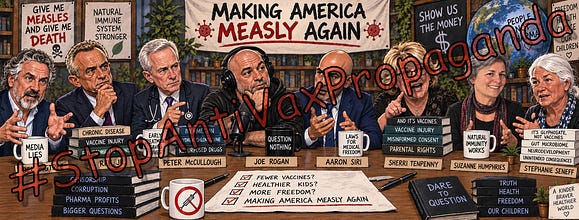
McCullough's grift group exists to give the false impression that there are "independent scientists" independently (of Children's Health Defense) showing their antivax "research", when in reality this is all being carefully coordinated by Kennedy who conveniently fired all the FOIA people at HHS so we can't examine his emails anytime this side of 2030.
I will guarantee there is AI slop in all this garbage they are posting on Zenodo, esp given Brian Hooker thanked his AI guy on one of his Zenodo PDFs https://bsky.app/profile/cphickie.bsky.social/post/3mf3kakf23s2u
I was thinking AI would almost certainly do a better job of it!
There's even more wrong with it ...
1. They claim only deaths that are believed to be associated will be reported. FALSE
2. They ignore immunity amnesia, deaths that occur because measles damages your immune system
3. Of course, measles cases, complications and deaths are a result of low vaccination rates. Their deliberate disinformation will lead to more suffering and death. When I say death, I'm talking about children in coffins, not VAERS reports
This piece nails the core mechanics of anti-vax messaging: it’s rarely one “big lie,” it’s a stack of smaller rhetorical moves that make doubt feel like intelligence; inflate rare harms, downplay disease severity, and then claim vaccines “don’t work,” all while laundering the talking points through a network so it looks consensus-y. 
From a clinician’s lens, the “worst thing about that” is the downstream psychology: once someone’s fear circuitry is recruited, they start selecting information that preserves the fear (and interpreting uncertainty as hidden proof). And that’s why shaming backfires; people don’t reason their way out of a threat state; they defend their identity inside it. 
What I appreciate here is that you’re not just calling it misinformation, but you’re teaching pattern recognition. That’s the public-health skill people actually need: spot the playbook, then return to baseline evidence (absolute risk, denominators, timing, plausibility, and what high-quality surveillance systems actually show).
Cannot agree more https://substack.com/@caringlens/note/c-256157118?r=70wxdu&utm