
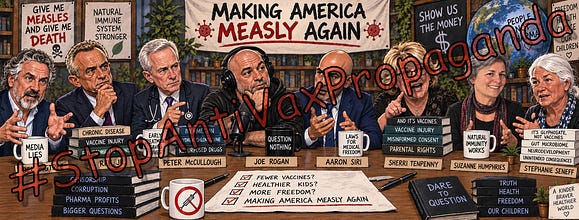

Can you guess what anti-vaccine influencers think caused an outbreak at Los Angeles County General Hospital in 1934?
Wait, an outbreak of what?
What Caused an Outbreak at Los Angeles County General Hospital in 1934?
Well, at the time, they thought it was an outbreak of atypical poliomyelitis, as there were many other cases of polio in the community.
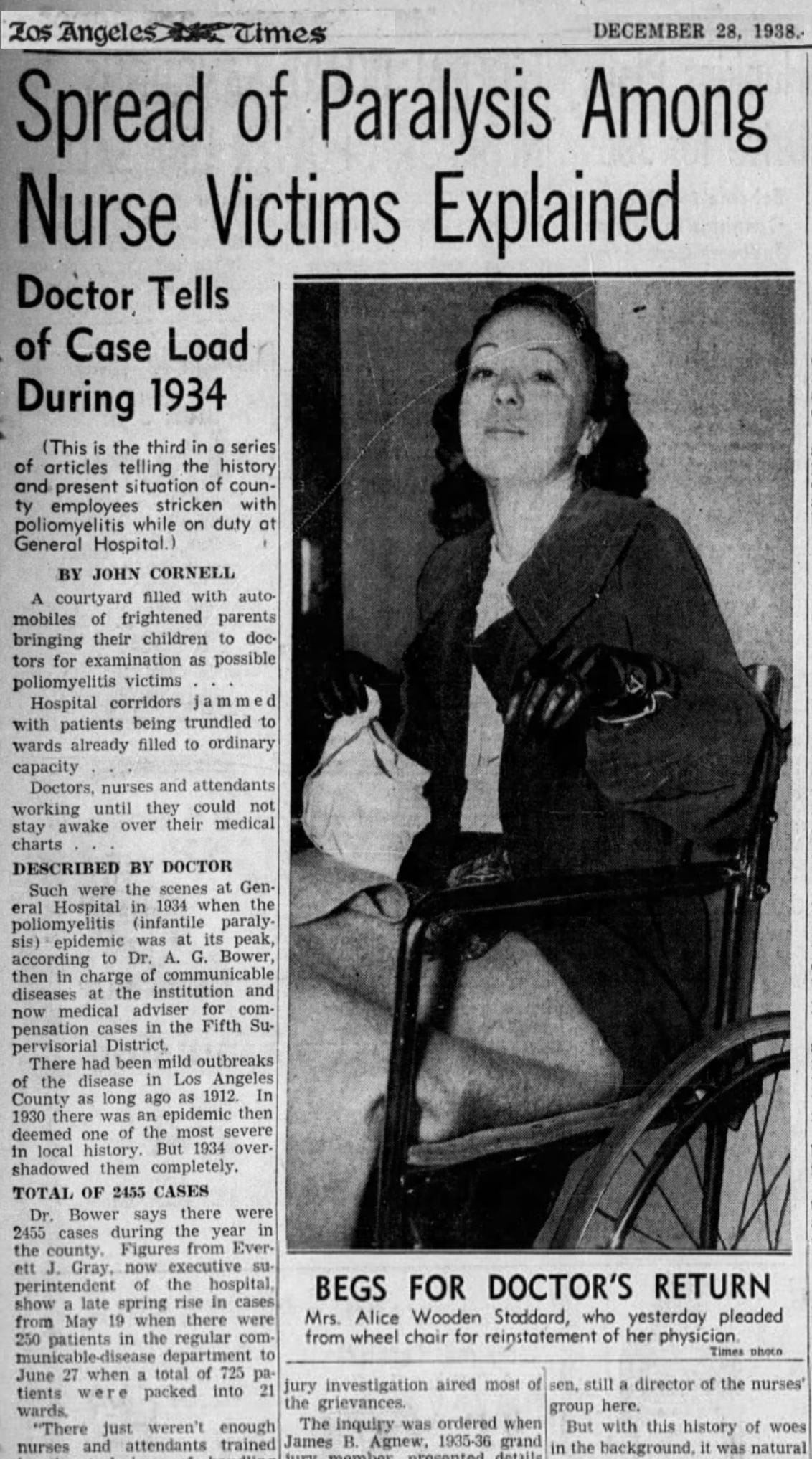
Why atypical polio?
“It would appear to be proper, in a study of this sort, to give an account of the temporal and spatial distribution of the cases, followed by only a brief description of the clinical course of the disease prevalent. In this study, however, this procedure cannot profitably be followed. The cases among adults, comprising this institutional outbreak, rarely exhibited the disability that is classically associated with poliomyelitis, namely, paralysis of a kind that might be expected to result from destruction of anterior horn cells. In a certain proportion of these cases a diagnosis of poliomyelitis would never have been considered had they not developed among persons intimately associated with an epidemic of the disease.”
Epidemiological study of an epidemic, diagnosed as poliomyelitis, occurring among the personnel of the Los Angeles County General Hospital during the summer of 1934
Well, although it was thought that they had polio, they didn’t all have symptoms of typical paralytic polio.
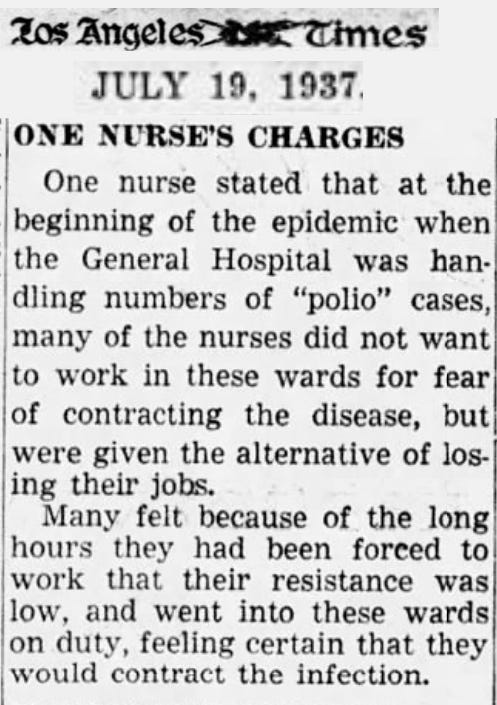
In fact, over time, some people began to believe that it could have been one of the first outbreaks of Myalgic Encephalomyelitis – Chronic Fatigue Syndrome!
And now?
And now, anti-vaccine influencers believe that they have found evidence that it was actually an outbreak of vaccine injuries!
“Dr. Alexander Gilliam’s Report (1938): The Buried Blueprint
After the 1934‑1935 Los Angeles County General Hospital outbreak, the U.S. Public Health Service sent Dr. Alexander (“Sandy”) Gilliam to investigate…
Gilliam’s paper became “restricted circulation” shortly after publication. Unlike other Public Health Service reports, it was never indexed properly in major medical databases during the mid‑20th century.”
The Historical Importance of the 1934 Los Angeles County Hospital Outbreak and beyond
Now, before we get into how ridiculous it is that anti-vaccine influencers are blaming this outbreak on vaccine injuries without any real evidence, let’s look at that buried/restricted circulation report.
Print editions of the “buried/restricted circulation report” that is available to borrow in most libraries...
Online editions of the “buried/restricted circulation report” that took me like 20 seconds to find and start reading…
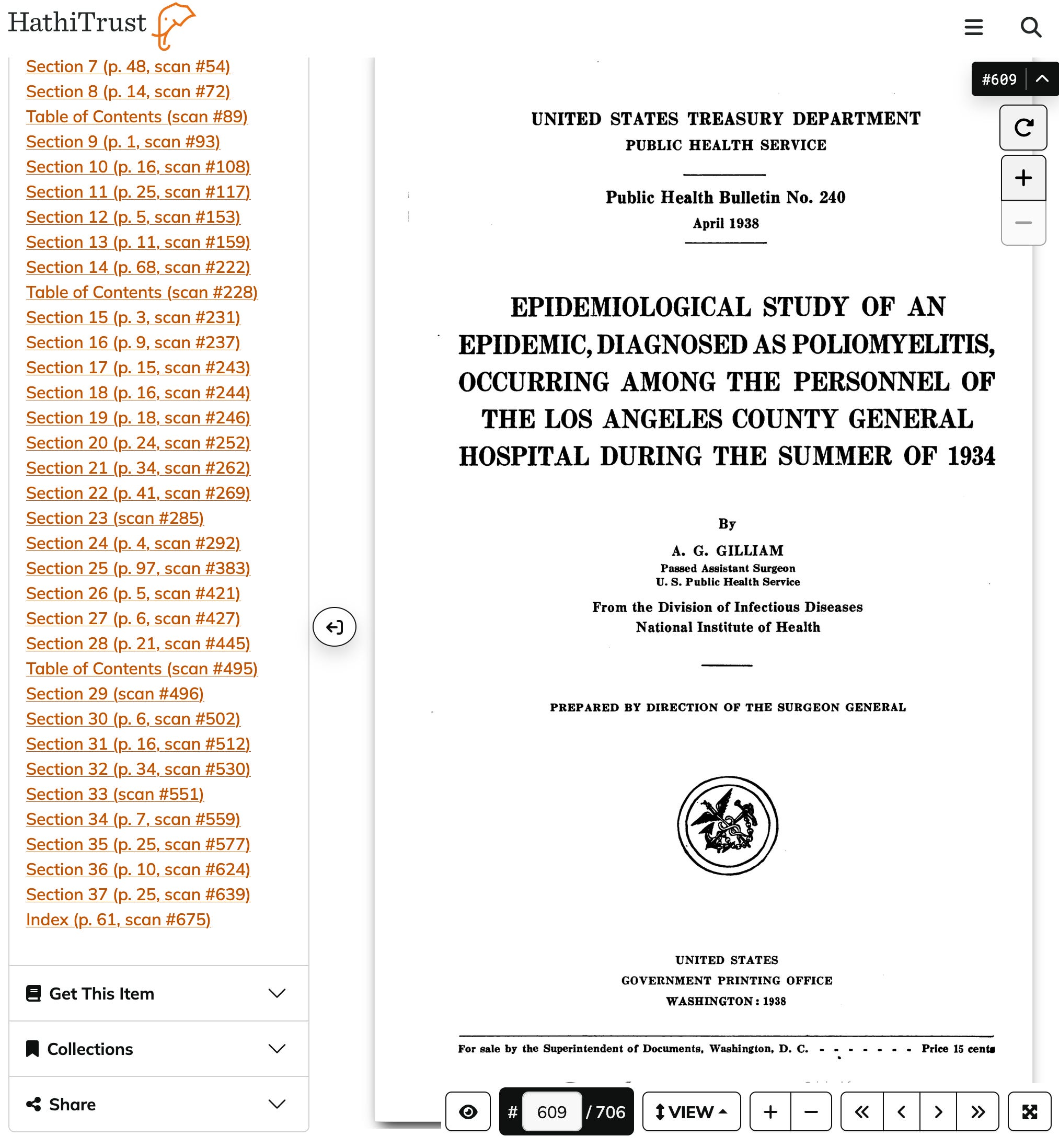
And no, Gilliam’s report did not suggest that any of the personnel in the Los Angeles County General Hospital outbreak of 1934 had received a vaccine.
It especially didn’t suggest that they had received a vaccine as part of any kind of polio vaccine experiment!
“Coincidently with an epidemic of poliomyelitis in the city and county of Los Angeles, Calif., in the summer of 1934, there occurred among the employees of the Los Angeles County General Hospital an epidemic of illness diagnosed at the time as poliomyelitis. If this diagnosis may be accepted in any large proportion of the cases, the epidemic is unique in the history of poliomyelitis because of the altogether unusual symptomatology, and the extraordinarily high attack rate in an adult population. If the disease were not polio-myelitis, the epidemic is equally extraordinary in presenting a clinical and epidemiological picture, which, so far as known, is without parallel.”
Epidemiological study of an epidemic, diagnosed as poliomyelitis, occurring among the personnel of the Los Angeles County General Hospital during the summer of 1934
Instead, Gilliam simply documented that there was an outbreak at the hospital that occurred during a polio epidemic in the city.
And that hospital personnel were exposed to a lot of people with polio and that the course of the outbreak closely followed the course of the epidemic.
“Gilliam cautiously avoided mentioning the experimental inactivated poliovirus preparation that had been administered earlier to staff.”
The Historical Importance of the 1934 Los Angeles County Hospital Outbreak and beyond
Also, it wasn’t caution that led Gilliam to avoid mentioning an experimental inactivated polio preparation or vaccine.
It was the simple fact that they didn’t receive one!
Sure, many of hospital workers got immunoglobulin, but it was no secret.
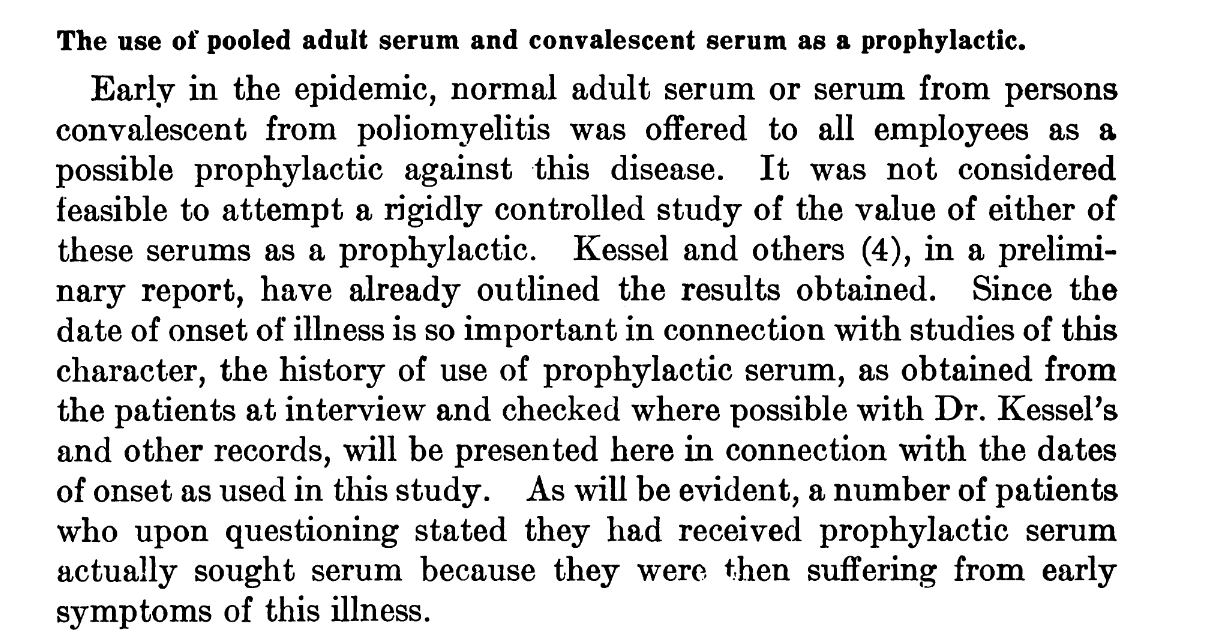
And it certainly didn’t cause the outbreak!
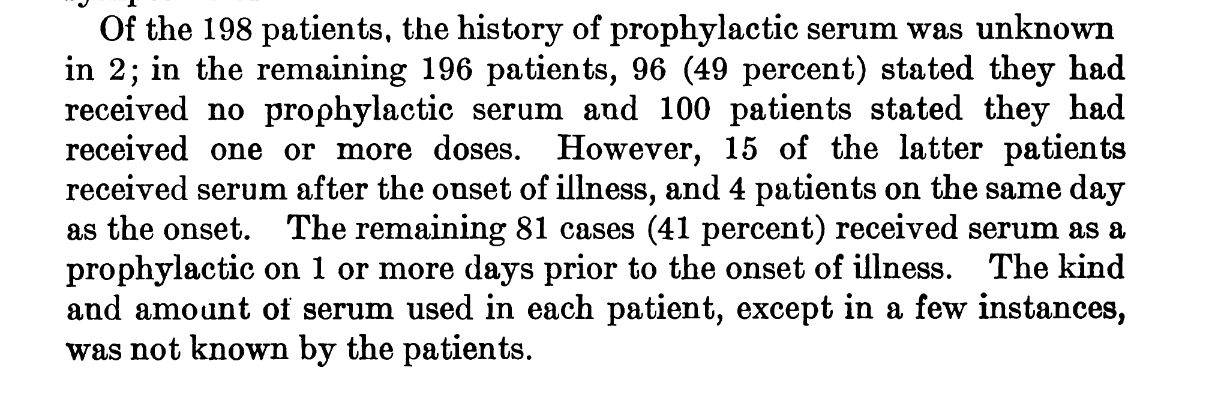
After all, many didn’t get it until after they started showing symptoms and nearly half didn’t get it at all!
“The prevalence of epidemic poliomyelitis in southern California has revived interest in treatment of the acute disease with serum. Largely as a result of the studies of Aycock and his associates, opinion had become crystallized that convalescent serum was highly effective in preventing and minimizing paralysis if given in the preparalytic stage. In the New York epidemic of 1931, Park carried out a rigorously controlled therapeutic experiment in which unselected alternate patients received convalescent serum in the preparalytic stage. He could find no difference either in incidence of paralysis or in mortality rates in the two groups.”
Serum Therapy in Poliomyelitis
And the use of serum therapy in poliomyelitis was hardly a secret!
In fact, it had already been used for over twenty years…
What else?
Well, while the first clinical trials for an inactivated (Maurice Brody) and live (John Kolmer) polio vaccine did start in 1934 and 1935, none of those affected at Los Angeles County General Hospital received one of these polio vaccines.
There are detailed case reports in Gilliam’s report, and they do not mention a polio vaccine.
Any way, those early clinical trials were instead in New York City, Philadelphia (and surrounding states), and Kern County, California.
And they were in children, not adults.
“In 1935, Brodie tried an inactivated vaccine with 10% formalin suspension of PV taken from infected monkey spinal cord; he tried it first on 20 monkeys, then on 3000 Californian children. The results were poor and additional human studies were never performed. In the same year, Kollmer tried a live attenuated virus consisting of a 4% suspension of PV from infected monkey spinal cord, treated with sodium ricinoleate. He used it on monkeys and then on several thousand children. The acute paralysis occurred in about 1/1000 vaccines shortly after administration and some cases were fatal.”
History of polio vaccination
Unfortunately, neither worked, and they may have caused adverse reactions, so it would be another twenty years before we got a working, safe polio vaccine.
Still, that they were already openly testing polio vaccines should help put to rest the conspiracy that anyone was secretly testing some kind of polio vaccine on hospital workers, right?
Well, probably not.
Hopefully though, all of this will help get you to become more skeptical of all of these claims of vaccine injuries from anti-vaccine influencers!
And it will help you to see how they actually create their anti-vaccine propaganda, like ventilators replaced iron lungs, DDT causes polio, or that we renamed polio to AFP, etc.