

Remember all of the stories of vaccine injuries after the DPT vaccines?
“Vaccination might trigger earlier onset of Dravet syndrome in children who, because of an SCN1A mutation, are destined to develop the disease. However, vaccination should not be withheld from children with SCN1A mutations because we found no evidence that vaccinations before or after disease onset affect outcome.”
Effects of Vaccination on Onset and Outcome of Dravet Syndrome: A Retrospective Study.
Remember when we found out that many of those children may have had Dravet syndrome, a genetic condition.
And that vaccines didn’t affect whether they would eventually develop Dravet syndrome?
“Vaccination does not cause DS, rather >90% of cases have a mutation in the SCN1A gene. Rather than the vaccine actually being causal, fever is thought to be the primary trigger of seizures following vaccination, especially given that warm temperatures and fever in general are a common seizure trigger among the population of individuals with DS.”
Dravet Syndrome and COVID-19 Vaccination
Well, maybe you haven’t, as many of those same people are still talking about vaccine injuries…
And we rarely seem to hear about Dravet syndrome anymore…
Update on Dravet Syndrome
So maybe it’s time for an update!
Let’s start with COVID.
“Given the risks of infection versus vaccination, expert clinicians continue to recommend patients with Dravet syndrome receive COVID-19 vaccinations.”
COVID-19 Vaccination and Dravet Syndrome
During COVID, many children and adults with Dravet syndrome received a COVID vaccine and did well, with very few having any increase in their normal seizure activity.
And they should get a yearly flu vaccine!
Incidence of Dravet Syndrome in Vaccine Injury Claims
What else?
Since the gene for Dravet syndrome was first described, we have learned more about its prevalence or how many people are affected.
“Of all reported seizures following vaccinations in the first year of life, 2.5% (95%CI:1.3 to 3.6%) were due to SCN1A-related Dravet syndrome, as were 5.9% of reported seizures (95%CI:3.1 to 8.7%) after 2(nd) or 3(rd) DTP-IPV-Hib vaccination.”
Prevalence of SCN1A-related dravet syndrome among children reported with seizures following vaccination: a population-based ten-year cohort study
In one study, 1.2% of children who had developed seizures following immunizations in the first two years of life were diagnosed with with SCN1A-related Dravet syndrome.
While that might not sound like at a lot at first, know that these are children with recurrent and hard to control seizures. They are not the more typical febrile seizures that go away without causing long term issues that we are more likely to see after vaccines.
“Knowledge on the specific characteristics of vaccination-related seizures in this syndrome might promote early diagnosis and indirectly, public faith in vaccination safety.”
Prevalence of SCN1A-related dravet syndrome among children reported with seizures following vaccination: a population-based ten-year cohort study
So, has knowledge of Dravet syndrome increased the public faiths in vaccination safety?
Well, it hasn’t kept some, even those who know that their child has Dravet syndrome, from blaming vaccines…
“Petitioners Christina and Bryan Osenbach filed a Vaccine Program petition (No. 16-419V) alleging that pneumococcal and IPV vaccines given to their son B.O. on April 17, 2013, significantly aggravated his pre-existing seizure disorder.”
Osenbach V. Secretary of Health and Human Services
It should be no surprise, that these cases typically fail in Vaccine Court though.
“The daughter of Jennifer and Gary Stone, Amelia, received a dose of the diphtheria-tetanus-acellular pertussis (“DTaP”) vaccine as part of her four-month well-child pediatric appointment. Stone v. Sec’y of Health & Hum. Servs., No. 04-1041V, 2010 WL 1848220, at *2 (Fed. Cl. Spec. Mstr. Apr. 15, 2010), mot. for rev. granted, 95 Fed. Cl. 233 (2010). The day after her vaccination, Amelia experienced two seizures, each of which lasted about thirty minutes. Id. at *2. After being hospitalized, Amelia was found to have returned to her usual state of health and an MRI did not identify any abnormalities. Id.
Following approximately two years of periodic seizures, a pediatric neurologist diagnosed Amelia as suffering from Dravet syndrome. Id. at *3. More than one year later, a genetic test revealed that Amelia possessed a de novo mutation in her SCN1A gene. Id.
Mr. and Ms. Stone alleged that the DTaP vaccine caused Amelia to develop Dravet syndrome.”
Stone V. Secretary of Health and Human Services
Vaccines do not cause Dravet syndrome.
Vaccines do not make Dravet syndrome worse.
And again, vaccines are important for children and adults with Dravet syndrome.
“Complications of other infections led to hospital admission in 52 children (68%) and included 43 ICU admissions within the first 2 years of life in 24 children (31%). In 2 of these ICU admissions, not only infection but also vaccination may have contributed to seizure aggravation. Two additional ICU admissions were only vaccination-associated.”
Effect of vaccinations on seizure risk and disease course in Dravet syndrome
Still, there are many other cases like this in the Vaccine Court system!
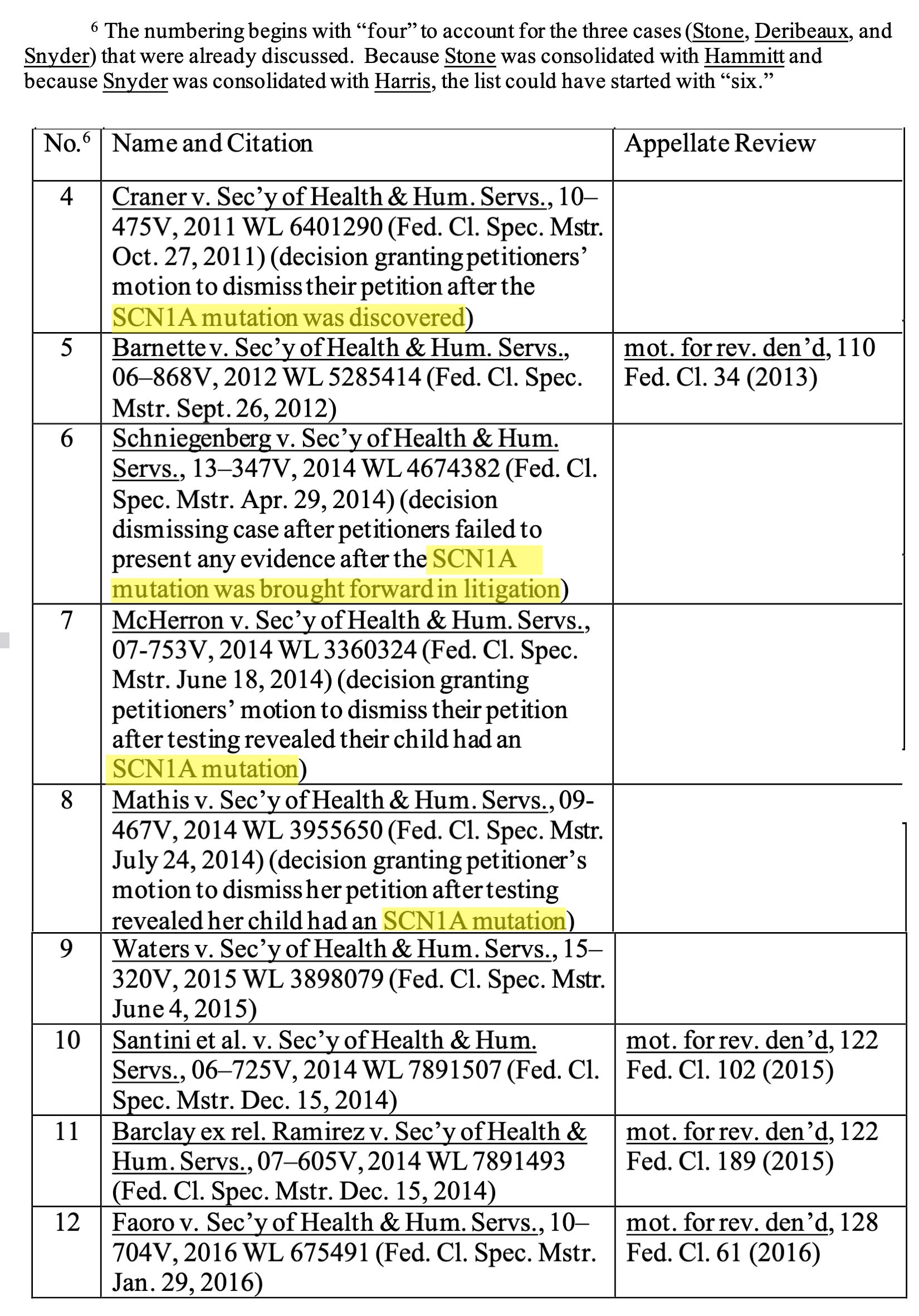
Vaccine injury cases that are dismissed because the children have a genetic disease causing their seizures.
Which makes you wonder…
Have all of the parents of children who developed seizures after a vaccine, especially hard to control seizures, had their child tested for Dravet syndrome?
“Dravet syndrome is a rare and severe developmental and epileptic encephalopathy, caused by pathogenic variants of SCN1A in 80%-90% of patients. It is a clinical diagnosis typically made in childhood, but many adults who may never have had appropriate genetic testing remain undiagnosed.”
Dravet syndrome diagnosed in adults
Especially now that there are better treatments for Dravet syndrome, it would be important for these children and adults to be tested and diagnosed.
“As precision medicine and gene therapies advance, it is increasingly important to make an accurate clinical and molecular diagnosis. Neurologists should consider Dravet syndrome in adults with early-onset epilepsy and intellectual disability.”
Dravet syndrome diagnosed in adults
After all, Dravet syndrome didn’t appear all of a sudden when the SCN1A mutation was discovered in 2001.
That’s simply when we learned how to make the diagnosis.
In fact, the oldest known patients with Dravet syndrome were born in the 1940s!
So how many people blamed a vaccine injury for their child’s seizures over the years, when it was more likely that they had Dravet syndrome, a condition that was just unknown at the time the child was growing up?
How many still haven’t been tested?
How many still blame a vaccine injury?
More on Dravet Syndrome
Why Are Anti-Vaccine Influencers Obsessed With the Movie Rain Man?
Effect of vaccinations on seizure risk and disease course in Dravet syndrome
Alleged cases of vaccine encephalopathy rediagnosed years later as Dravet syndrome
Dravet syndrome as epileptic encephalopathy: evidence from long-term course and neuropathology
Prevalence of SCN1A-Related Dravet Syndrome among Children Reported with Seizures following Vaccination: A Population-Based Ten-Year Cohort Study
Well resourced article about a rare, identifiable, and now treatable genetic condition whose seizure symptoms onset in infancy and early childhood is concurrent with, but not caused by, well baby vaccinations.
Again, correlation is NOT causation. And a mistaken, but stubborn insistence on viewing a genetic condition causing seizures as a "vaccine-related injury", denies affected children proper diagnosis and treatment. And, once again we are reminded that a lawyer who stated "I have no fear of germs (because) I sniffed cocaine off of toilets seats" shows so many intellectual and character flaws in one sentence, that he should never ever be allowed to set policy for public health for anyone, anywhere, anytime.
There is a new, very effective treatment available for Dravet syndrome…an antisense oligonucleotide that upregulates the sodium channels.
https://www.nejm.org/doi/full/10.1056/NEJMoa2506295