

You know what happens when an infectious disease is introduced into a community that has no natural or vaccine induced immunity, right?
Yep, just about everyone gets sick!
Extreme Mortality After First Contact with Measles
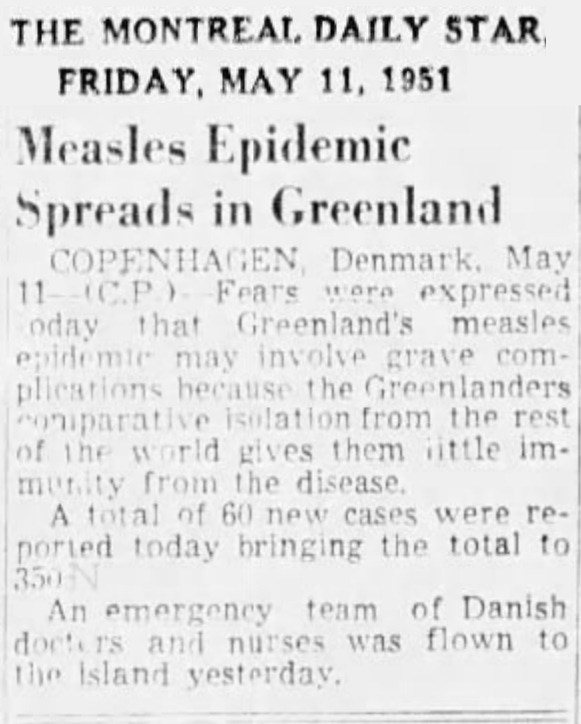
Believe it or not, that’s what happened in Greenland in 1951.
Sure, we have heard about other measles epidemics like this, including when:
measles was introduced to the Faroe Islands in 1846 and killed hundreds of islanders
measles was introduced to Hawaii in 1848 and killed up to a third of the population of the islands
measles was introduced to Fiji in 1875 and killed up to a third of the population of the island
measles was introduced to Rotuma in 1911 and killed just over 12% of the population of the Pacific island
But the epidemic in Greenland was far more recent!
That Time Measles Hit Greenland
So what happened?
In 1951, measles finally made it to Greenland, where about 24,000 people lived at the time - mostly in small Inuit coastal settlements under Danish colonial rule.
“On April 6th, 1951, the sG. C. Amdrupa, belonging to the Greenland Depart- ment, left Copenhagen for Julianehlb, having on board a young Greenlander, Manasse, who had been signed on as a deck hand. During the days before his departure Manasse had been in close contact with a Greenlander living in Denmark, who a couple of days after Manasse’s departure developed measles.
On April 16th the nG. C. Amdrupo arrived at Julianehib, and Manasse was discharged there. Immediately after his return home he looked up a number of his acquaintances, and on April 22nd he took part in a dancing-mik at Julianehåb. A dancing-mika is a typical Greenlandic entertainment, attracting a very great number of the inhabitants of the community, who enjoy this interruption of their rather monotonous daily life. The day after this mik Manasse felt ill with sore throat and cough, but he did not consult the district medical officer until the 26th, having noticed a rash on his body the previous day. The incubation period for the source of the epidemic was remarkably long, 19 days having elapsed from the time of infection, which cannot have been later than April 6th, until the appearance of the rash.
About May 1st the first cases of measles infected by Manasse appeared at Julianehåb, and on May 4th there were 57 patients in the prodromal stage and five patients with a rash. ”
An epidemic of measles in southern Greenland, 1951; measles in virgin soil. II. The epidemic proper
And nearly all of them got sick.
“During the epidemic in 1951 in the southern part of Greenland, only 5 theoretically susceptible persons out of a total of 4,262 individuals did not contract the disease. This corresponds to a morbidity of 999 per 1,000.”
Measles epidemics in Greenland
And many developed complications, like pneumonia, cardiac insufficiency, and measles encephalitis.
“During the epidemic in southern Greenland in 1951 the total mortality was 18 per 1,000. Several deaths occurred in the prodromal phase (25 out of 77), and the majority of the remainder within 14 days after the appearance of rash.”
Measles epidemics in Greenland
It should also not surprise anyone that many people in Greenland died during this epidemic.
“The mortality was much lower than might have been expected, probably owing to penicillin treatment of complications combined with the modifica- tion produced by sero-prophylaxis of about 1000 people, both of which measures were rapidly organised from Denmark. Only 77 deaths were recorded-a rate of 18 per 1000.”
Measles in Virgin Soil
Why did so many people die though?
After all, a rate of 18 per 1000 is very high as compared to the 1 per 1000 we are used to seeing.
“The mortality was greatest in the age groups over 55 years and lowest in the group between 2 and 14 years.”
Measles epidemics in Greenland
Can you guess?
Since this was their first introduction to measles, no one had any immunity, so even the oldest members got sick. And like the youngest members, they are the most at risk for complications from measles.
There was also a lot of TB among this population at the time, as it was just before the BCG vaccine was introduced in Greenland.
“In the 1950s, the Inuit population in Greenland presented the highest tuberculosis (TB) disease incidence rates (IR) ever observed worldwide with an IR of 2,200 cases per 100,000 inhabitants in 1952.”
Ten years of tuberculosis intervention in Greenland - has it prevented cases of childhood tuberculosis?
Mostly though, this is just what happens after first contact with measles!
And no, that doesn’t make a case for natural immunity, as you are at risk for dying with measles at any age.
Remember, you have to earn your natural immunity.
Well, you don’t have to.
You can just get vaccinated now!
"May 1st".
Sounds like a sun rash enhanced with superstitious beliefs and dangerous "measles" treatments.
https://www.youtube.com/watch?v=foNp2-9Y8Cw&sttick=0