

HPV is the virus that can cause cervical cancer and some other cancers.
Surprisingly, with all the proof we have seen over the years that our HPV vaccines are working to prevent HPV infections and these cancers, there are still some people who don’t think that they are safe or that they work.
More Proof That HPV Vaccines Are Working
So let’s take a look at all of that evidence and see if we can finally shut down those people once and for all…
In many countries, you can simply look at their cancer registries and see that rates of invasive cervical cancer are already starting to drop in young girls.
Sweden - found that “among Swedish girls and women 10 to 30 years old, quadrivalent HPV vaccination was associated with a substantially reduced risk of invasive cervical cancer at the population level.”
Scotland - found that “the bivalent vaccine prevents the development of invasive cervical cancer.”
England - found that “the high effectiveness of the national HPV vaccination programme previously seen in England continued during the additional 12 months of follow-up. HPV vaccination was associated with a substantially reduced incidence of cervical cancer and CIN3 across all five deprivation groups, especially in women offered routine vaccination.”
United States - found that “observed declines in cervical precancers are consistent with HPV vaccination impact and support Advisory Committee on Immunization Practices recommendations to vaccinate children against HPV at age 11–12 years with catch-up through age 26 years.”
Australia - for the first time ever, “there were no cervical cancer cases diagnosed in women aged <25 years,” and Australia is on track to become the first country to eliminate cervical cancer!
Netherlands - found that “the risk of cervical cancer and CIN3+ was strongly reduced in vaccinated women indicating that vaccine protection extends at least until age 30.”
Denmark - found that “the HPV vaccine has been effective in reducing infections with vaccine-covered HPV types (HPV16/18), the HPV types responsible for over 70% of cervical cancer.”
There are also many studies that confirm that HPV vaccines are safe and that they work, including (but definitely not limited to):
a 2026 study using the US Cancer Statistics database, State-level progress in reducing cervical cancer incidence among US young women between the pre- and post-human papillomavirus vaccination eras, found that “Declines in cervical cancer incidence in young women during the HPV vaccination era varied substantially by state, aligning with HPV vaccination rates.”
a 2025 NEJM trial, Noninferiority of One HPV Vaccine Dose to Two Doses, found that “one dose provided protection against persistent cervical HPV infections.”
a 2025 Cochrane review, Effects of human papillomavirus (HPV) vaccination programmes on community rates of HPV-related disease and harms from vaccination, found that “there are now long-term outcome data from different countries and from different study designs that consistently report a reduction in the development of high-grade CIN and cervical cancer in females vaccinated against HPV in early adolescence. Data show that there is greater benefit to vaccinating younger adolescents prior to becoming sexually active. There is evidence that HPV vaccination does not increase the risk of the most common adverse events reported on social media.”
another 2025 Cochrane review, Human papillomavirus (HPV) vaccination for the prevention of cervical cancer and other HPV‐related diseases: a network meta‐analysis, found that there were “no safety concerns noted in the studies,” and that “there is evidence from randomised controlled trials that HPV vaccination reduces the risk of pre‐cancerous outcomes such as CIN2+ and anogenital warts.”
a 2025 Swedish study, Population-Level Impact of Human Papillomavirus Vaccination on the Incidence of Genital Warts in Sweden, found “decreases of GW incidence in women and men following increased vaccination coverage”
another 2026 Swedish study, Quadrivalent Human Papillomavirus Vaccine and High-Grade Vulvovaginal Lesions, found that “vaccinated women had a lower incidence of high-grade vulvovaginal lesions compared with unvaccinated women”
a 2019 VAERS study, Safety of the 9-Valent Human Papillomavirus Vaccine, analyzed postlicensure surveillance reports to VAERS found that “no new or unexpected safety concerns or reporting patterns of 9vHPV with clinically important AEs were detected.”
a 2018 Danish and Swedish study, Human papillomavirus vaccination of adult women and risk of autoimmune and neurological diseases, “did not raise any safety issues of concern”
While none of this will likely stop anti-vaccine influencers from trying to scare you away from getting vaccinated and protected, it will hopefully help you ignore them!
“The benefits of the HPV vaccine are, at this point, beyond doubt. Randomized controlled trials like FUTURE I and FUTURE II and Cochrane reviews of the data have demonstrated the vaccine’s ability to prevent the many diseases caused by HPV infection.”
We Can Now Envision an End to Cervical Cancer
Remember, getting your child an HPV vaccine, which have now been around for nearly 20 years, is a great way to protect them from getting cancer.
But what about the idea that changes in cervical cancer screening guidelines are more responsible for drops in cervical cancer? While it is an interesting idea, it doesn’t hold up when you consider the study that correlates drops in cervical cancer to higher HPV vaccine rates!
What about the idea that many HPV infections clear up on their own? While it is true that up to 90% of HPV might clear on their own, that does mean that at least 10% don’t. And it is these persistent HPV infections that are at the highest risk of causing cancer.
And screening obviously isn’t enough, as even with screening, we have had at least 4,000 deaths from cervical cancer each year in the United States. Also, screening for cervical cancer doesn’t do anything about the other types of cancer that can be caused by HPV infections!
Bottom line - HPV vaccines are safe and effective and some parents are now beginning to regret skipping it, as their intentionally unvaccinated kids develop HPV infections.
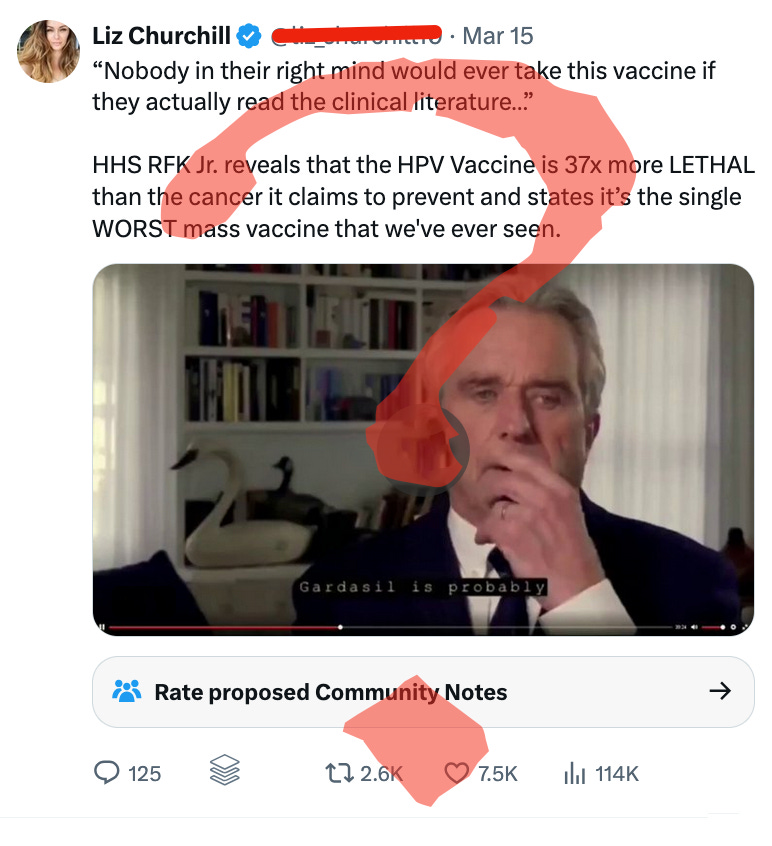
What was the evidence RFK was suggesting shows the vaccine is “37 times more lethal” than HPV related cancers?
In 2010 (when vaccines would have no impact on numbers) there were 4,000 deaths from cervical cancer, 700 deaths from anal cancer and 8,000 deaths from oropharyngeal cancer. Total 12,700 deaths.
Is RFK suggesting that the HPV vaccine causes 470,000 deaths a year?
Has the brain worm finally eaten the entirety of his frontal lobes?
All I know is that I’m relieved that this vaccine was available for my son.