
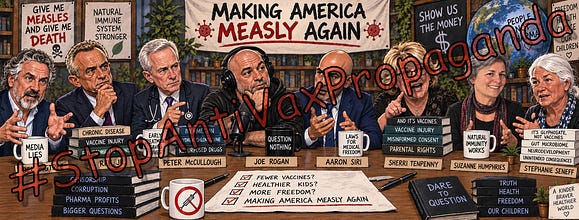

Why are we talking about rapid onset autism?
Well, only because an anti-vaccine influencer is talking about, pushing propaganda about autistic triplets.
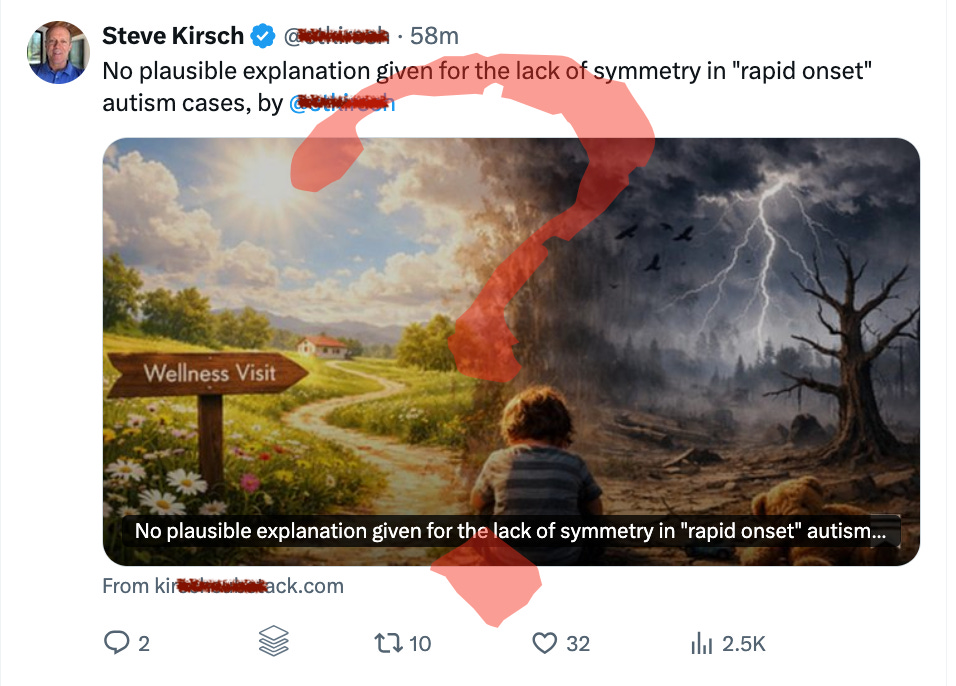
Steve Kirsch is even offering a $1,000 reward (with a lot of stipulations) if any pediatrics practice can offer evidence of these kinds of rapid onset autism cases occurring a week before a scheduled vaccine appointment.
Let’s Talk About Vaccines and Rapid Onset Autism
As usual though, Steve Kirsch is getting a lot wrong.
First of all, he doesn’t mention many of the cognitive biases that would affect the connecting of a diagnosis of autism to just after a visit to the pediatrician and any vaccines given at that visit.
What kind of biases?
These well known cognitive biases include:
temporal binding bias - makes the time between a cause and its effect appear to be shorter than it is
availability bias - makes people overestimate the importance of recent events, like a visit to their pediatrician
post hoc bias - a temporal causation bias that makes people link two events just because they happened close to each other. And of course, if you noticed the symptoms of autism just before your visit, there is nothing to link it to!
recall bias - parents often forget early subtle signs of autism, thinking that their child was developing perfectly up until they got a vaccine that triggered their autism, even though many studies of these same children can see the signs on earlier baby videos
confirmation bias - since Andy Wakefield’s fraudulent paper was published and publicized in 1999, it is easy for parents to find support once they think that a vaccine might have triggered their child’s autism.
hindsight bias - leads you to connect earlier events, even though they are unconnected. So at a visit to your pediatrician, they may have noticed some developmental delays or other concerns, or they may have missed a lot of questions on their MCHAT, and then later, the parent connected the visit and the vaccine given at the visit with a diagnosis of autism.
If Steve Kirsch has heard of any of these kinds of cognitive biases, he doesn’t seem to mention them in any of his writings about autism…
“There are thousands of similar stories from parents all over the world of their child developing normally and then, hours to days after a vaccine, the child all of a sudden transitioned into exhibiting classic ASD behaviors, generally for the rest of their lives.”
No plausible explanation given for the lack of symmetry in “rapid onset” autism cases
Nor does he mention all of the unvaccinated kids with autism.
How do they fit into his theory that there would be no kids who developed autism before their visit to their pediatrician and getting a vaccine?
Fortunately, we don’t have to listen to Steve Kirsch or any of his vaccine injury stories to get a definitive answer about any of this!
“Questions about when and how behavioral signs of autism emerge may be better answered through prospective studies, in which infants are enrolled near birth and followed longitudinally until the age at which ASD can be confidently diagnosed or ruled out.”
Changing conceptualizations of regression: What prospective studies reveal about the onset of autism spectrum disorder
We can instead look at the results of prospective studies that looked at children from birth to when they were diagnosed with autism, or found to not have autism.
“Our team (Ozonoff et al., 2010, 2011a) and others (Pearson et al., 2018; Rogers, 2009; Szatmari et al., 2016; Thurm et al., 2014) have suggested that onset is better thought of dimensionally, as a continuum of age when social and communication behaviors begin to diverge or decline, rather than a dichotomy (regression v. early onset). In a dimensional conceptualization of onset, at one end of the continuum lie children who display declines so early that they are difficult to measure and symptoms appear to have always been present. At the other end of the continuum are children who experience losses so late, when more skills have been acquired and thus there are more skills to lose, that the regression appears quite overt and dramatic.”
Changing conceptualizations of regression: What prospective studies reveal about the onset of autism spectrum disorder
These studies find high rates of regression in autism.
Infants are typically on track in their development and then either have either early, or late regression in their developmental skills.
And not surprisingly, none of this is correlated with getting vaccines!
There has even been a study confirming this!
“Overall, our findings suggest that when parental description of ASD onset in their children is examined against parent report of vaccine receipt, there is no association between pattern of onset and receipt of any type of vaccines. This does not support assertions that regressive-onset ASD is triggered by vaccines.”
Parental report of vaccine receipt in children with autism spectrum disorder: Do rates differ by pattern of ASD onset?
In the study, Parental report of vaccine receipt in children with autism spectrum disorder: Do rates differ by pattern of ASD onset?, they looked to see if vaccination rates were higher in kids with regressive autism.
They weren’t.
“The case-series analyses showed no evidence of temporal clustering between MMR or other measles- containing vaccines and diagnosis of autism. Regression, as reported in other studies, occurred in nearly a third of the cases of core autism; regression was not clustered in the months after vaccination.”
Autism and measles, mumps, and rubella vaccine: no epidemiological evidence for a causal association
Other studies that looked at other vaccines, like MMR, didn’t find any association with regressive autism either.
There have even been studies about the medical histories of autistic children and their visits to the pediatrician.
“There were no significant differences between the groups for the age of vaccination or for number of pediatrician visits.”
Early medical history of children with autism spectrum disorders
And they found that vaccines are not associated with autism.
More on Vaccines and Autism
Why are there so many reports of autism following vaccination? A mathematical assessment
Vaccines Don’t Cause Autism, But That’s Not The Point. Stop Being Ableist.
Parents’ Early Concerns About Their Child with Autism: Relation to Age of Diagnosis
Autism and measles, mumps, and rubella vaccine: no epidemiological evidence for a causal association
Early medical history of children with autism spectrum disorders
Kirsch has two problems. One is that he doesn't know what he doesn't know and the other is his hubris thinkig that just because he has a MIT masters degree in engineering that he is capable of understanding complex fields outside his area of expertise.