

There is something different about the latest alert about a measles exposure from the Allen County Health Department.
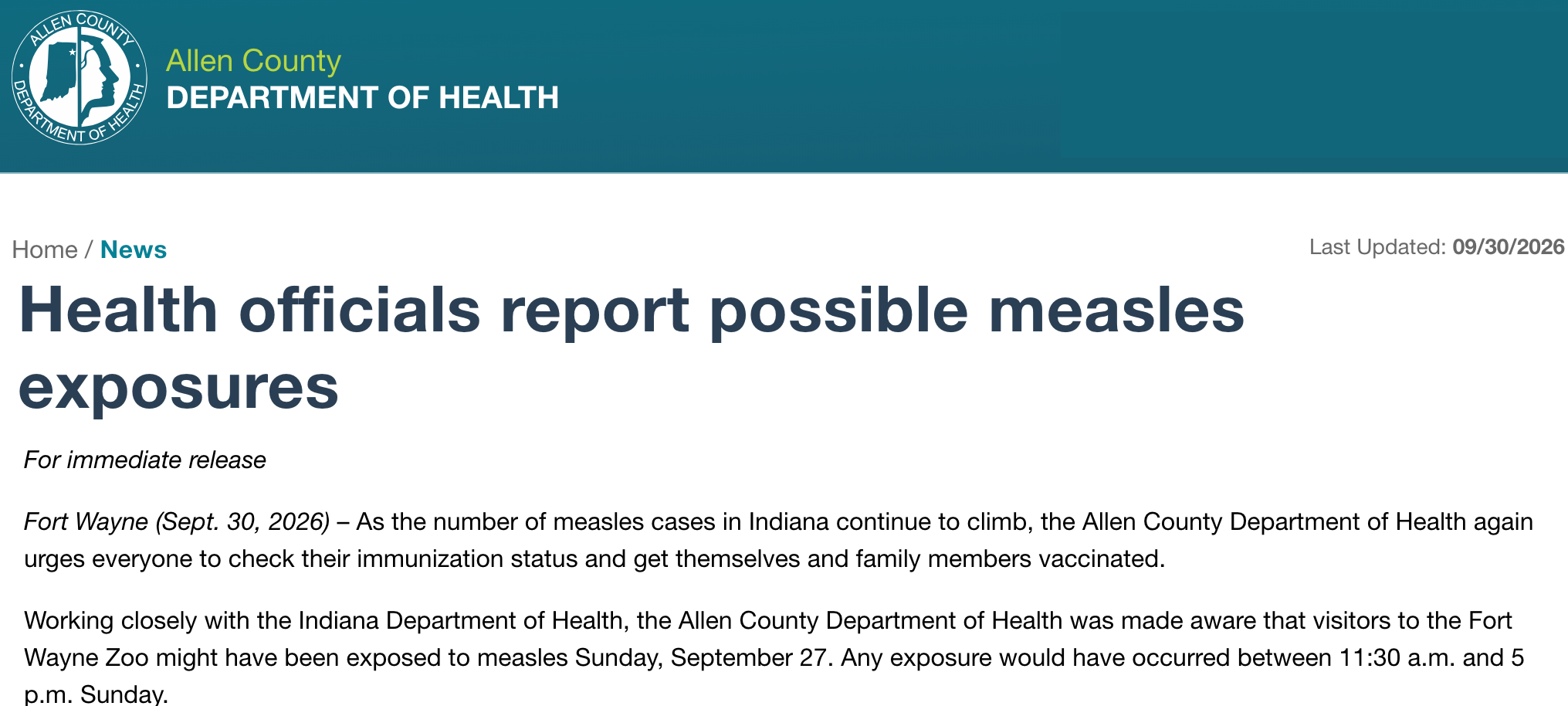
The exposure was at the Fort Wayne Zoo!
Let’s Talk About the Measles Alert at the Fort Wayne Zoo
If you were at the Fort Wayne Zoo between 11:30 a.m. and 5 p.m. Sunday, September 27, then you might have been exposed to measles.
“Health officials urge people present at that location during that time to check their measles, mumps and rubella (MMR) vaccination status and monitor themselves for symptoms of measles for 21 days. People exposed and who have not received the MMR vaccine should quarantine for 21 days after exposure and discuss receiving the vaccine with their doctor.”
Health officials report possible measles exposures
Hopefully, if you were there, you are vaccinated and protected, with two doses of the MMR vaccine.
But what about “others” who might have been exposed?
Others?
Now, while humans are the only natural reservoir for measles, some other animals can and do get measles!
Which animals?
“Humans are the natural host for this virus, but most non-human primate species, particularly macaques, are susceptible to infection. Infection with measles can have serious consequences including fatality. Measles-virus infections in marmosets can rapidly spread through a colony resulting in high morbidity and mortality.”
Revised recommendations for health monitoring of non-human primate colonies (2018): FELASA Working Group Report
Nonhuman primates, of course.
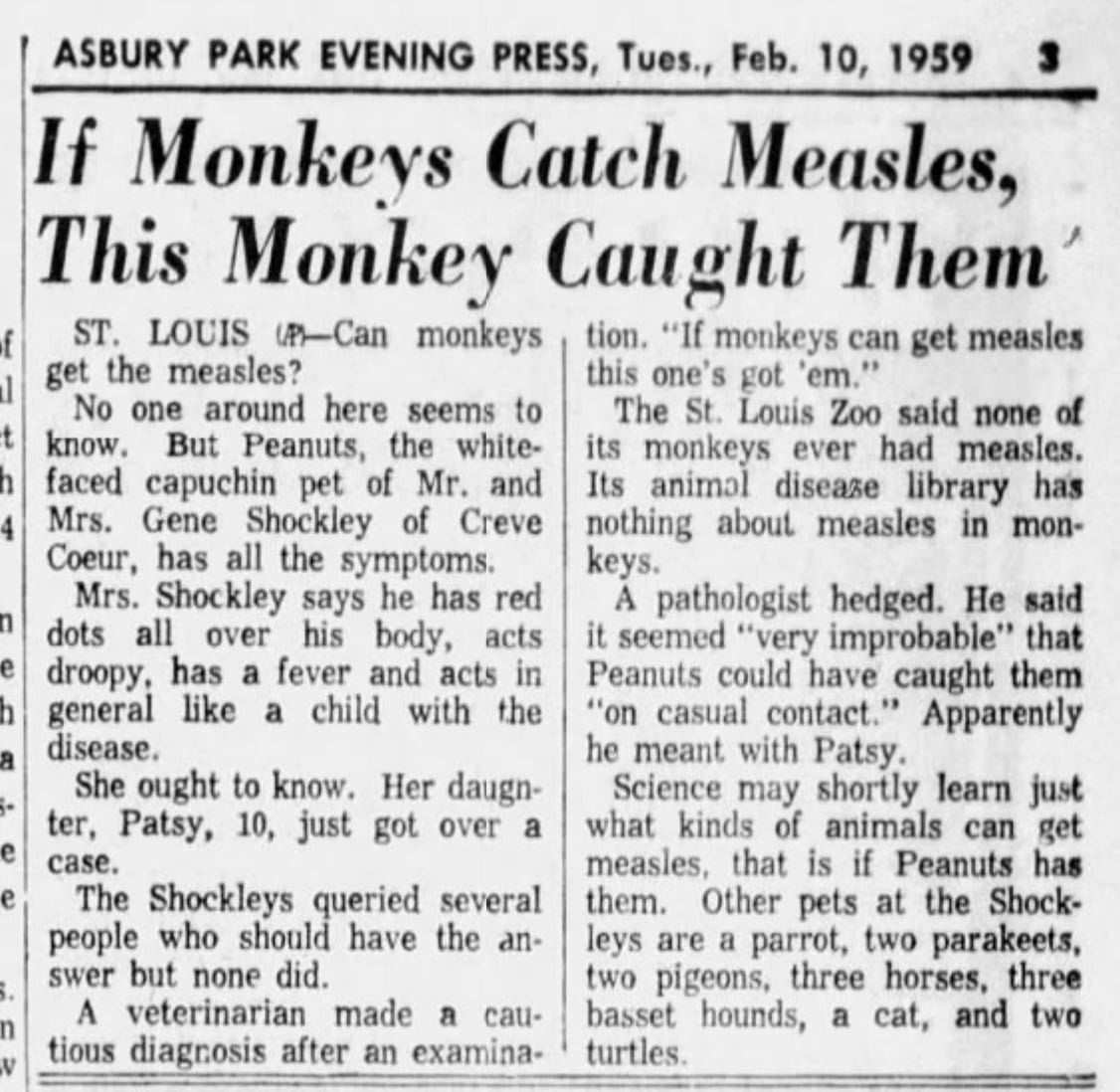
But if nonhuman primates can get measles, then why don’t they get it more often?
“Measles is endemic only in high-density human populations. There is a density threshold below which MV cannot be maintained in a population due to very efficient transmission and rapid exhaustion of susceptible hosts. However, apes and both Old World and New World monkeys are susceptible to MV infection. Because wild NHP do not live in populations large enough to exceed the endemic maintenance threshold, measles is not a naturally occurring infection.”
Multicenter Safety and Immunogenicity Trial of an Attenuated Measles Vaccine for NHP
Interestingly, they actually used to get measles fairly often, typically when captured or kept in high-density facilities.
“In 1986 to 1987 a large measles outbreak occurred at the California National Primate Research Center, with 147 recognized NHP cases (Macaca mulatta and M. fascicularis) and 28% mortality (not including stillbirths). The cost to treat infected animals was approximately US$187,000, not including animal loss due to secondary infection or abortion. During this same time period, 5 human cases among human contacts were documented. Epidemiologic evidence suggests instances of NHP-to-human MV transmission in this outbreak, raising occupational health concerns.”
Multicenter Safety and Immunogenicity Trial of an Attenuated Measles Vaccine for NHP
It is likely only that measles has been under better control that we don’t see them getting sick more regularly these days.
And yes, there are measles vaccines for nonhuman primates.
That’s good news, as we may need them.
After all, the Fort Wayne Zoo has a number of ape and primate exhibits, including:
Orangutan Valley - an immersive Indonesian Rainforest exhibit for the zoo's orangutans
African Journey and Indonesian Rainforest areas with Colobus Monkeys, De Brazza's Monkeys, Swamp Monkeys, and capuchins.
Apes and primates that could have been exposed to measles too.
“An outbreak of natural measles virus infection occurred in a group of Japanese macaques (Macaca fuscata). Over a period of 4 months, 12 of 53 Japanese macaques died following a 2-23-day history of anorexia, diarrhea, and dermatitis… The primary infective source or the mode of infection could not be determined in this outbreak, but measles virus may have been transmitted to the monkeys from human visitors while the monkeys were on exhibit.”
Fatal measles virus infection in Japanese macaques (Macaca fuscata)
An exposure that could lead to a large outbreak and many deaths.