


A lot of good studies have been published showing that the HPV vaccines are safe and effective, so when you see an anti-vaccine influencer pushing one saying they don’t work, you should be skeptical.
They work so well, in fact, that many countries have moved to a one dose schedule!
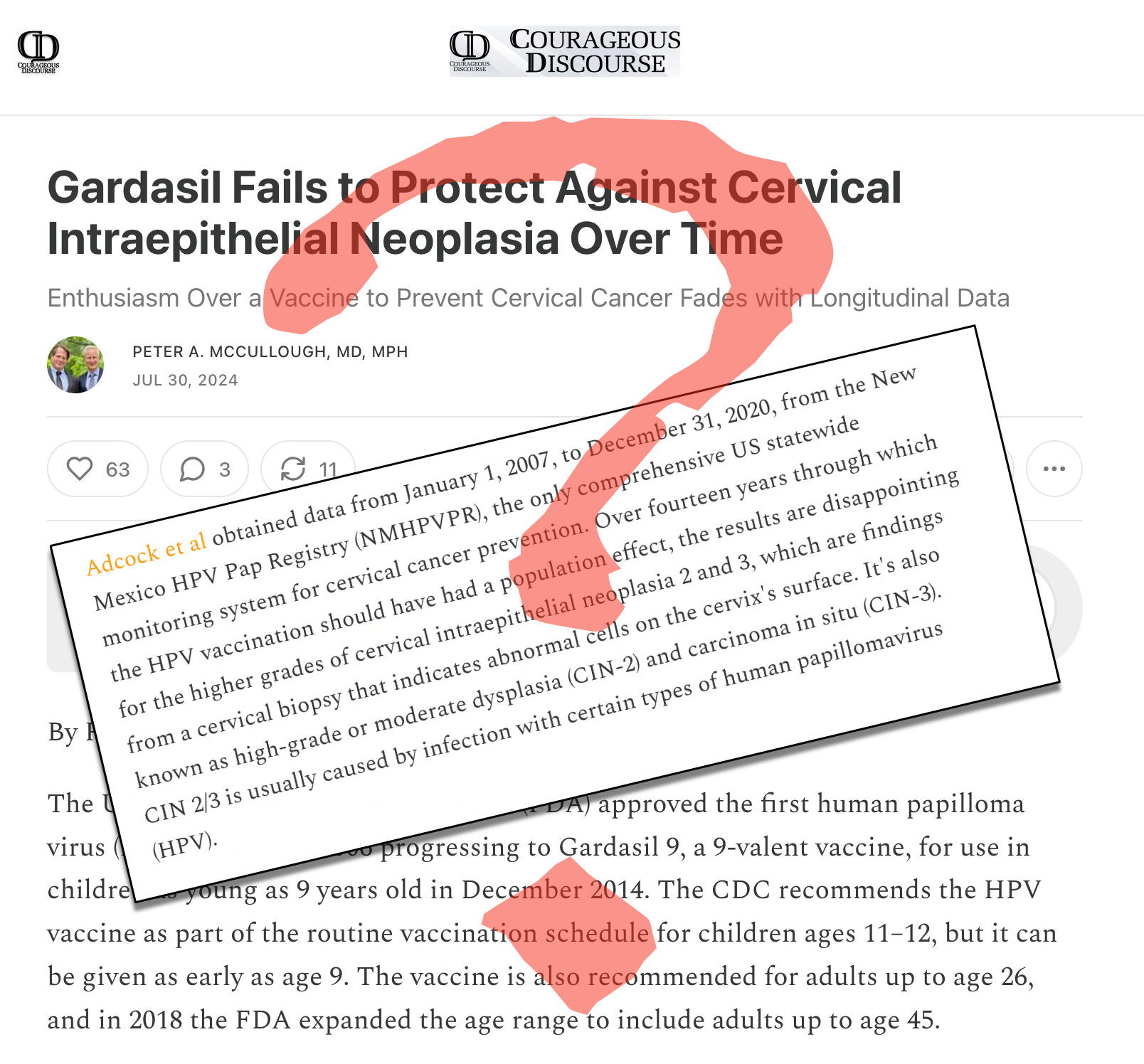
So why is Peter McCullough saying that the results of a new Gardasil study are ‘disappointing’ and that it fails to protect women from higher grades of cervical intraepithelial neoplasia 2 and 3?
The study he is talking about, Population-Based Incidence of Cervical Intraepithelial Neoplasia Across 14 Years of HPV Vaccination, was recently published as a research letter.
However, it doesn’t say that Gardasil is disappointing anyone. In fact, as a population based study, it doesn’t even include the vaccination status of the women in the study.
A population based study that found large reductions in the incidence of cervical intraepithelial neoplasia (CIN) grades 1, 2, and 3 in women younger than 25 years of age.
“Persistent infection with human papillomavirus (HPV) can cause high-grade cervical intraepithelial neoplasia (CIN), which can progress to invasive cervical cancer if left untreated.”
Population-Based Incidence Rates of Cervical Intraepithelial Neoplasia in the Human Papillomavirus Vaccine Era
Why is that important?
That’s the age group most likely to have already had one or more HPV vaccines!
“In New Mexico, the mean uptake of all 3 doses of HPV vaccine among female individuals (age range, 13-17 years) in 2014 was 40%. In earlier years, the uptake ranged from 17% (in 2008) to 38% (in 2013).”
Population-Based Incidence Rates of Cervical Intraepithelial Neoplasia in the Human Papillomavirus Vaccine Era
The study also found “overall increases in CIN2 and CIN3 incidence among those aged 25 to 29 years,” but again, this age group would have been less likely to have already benefited from the HPV vaccines.
The study ends by stating:
“If high HPV vaccination coverage is sustained, the age at which cervical screening initiation is recommended might be increased further and the number of lifetime cervical screens potentially reduced.”
Population-Based Incidence of Cervical Intraepithelial Neoplasia Across 14 Years of HPV Vaccination
And somehow Peter McCullough twisted that into the idea that Gardasil doesn’t work…
In reality, they are saying that Gardasil works so well, that those who are fully vaccinated and protected will likely need fewer screenings for cervical cancer!
How is that going to happen?
“The introduction and uptake of HPV vaccination in 2007 and the entry of vaccinated cohorts, now in their 20s, into the screening-eligible age range are expected to have a substantial impact on cervical cancer screening strategies and outcomes in coming years. The initial uptake of the HPV vaccine was slow in the United States after FDA approval in 2006, but current enhanced dissemination efforts have resulted in steadily increasing levels of vaccination and population coverage at the recommended ages of 11 to 12 years.”
Cervical cancer screening for individuals at average risk: 2020 guideline update from the American Cancer Society
We need to StopAntiVaxPropaganda!
References:
Adcock R, Kang H, Castle PE, et al. Population-Based Incidence of Cervical Intraepithelial Neoplasia Across 14 Years of HPV Vaccination. JAMA Oncol. Published online July 25, 2024. doi:10.1001/jamaoncol.2024.2673
Benard VB, Castle PE, Jenison SA, Hunt WC, Kim JJ, Cuzick J, Lee JH, Du R, Robertson M, Norville S, Wheeler CM; New Mexico HPV Pap Registry Steering Committee. Population-Based Incidence Rates of Cervical Intraepithelial Neoplasia in the Human Papillomavirus Vaccine Era. JAMA Oncol. 2017 Jun 1;3(6):833-837. doi: 10.1001/jamaoncol.2016.3609.
Fontham ETH, et al. Cervical cancer screening for individuals at average risk: 2020 guideline update from the American Cancer Society. CA Cancer J Clin. 2020 Sep;70(5):321-346. doi: 10.3322/caac.21628. Epub 2020 Jul 30.