


Since the Amish don’t typically follow the standard immunization schedule, only getting vaccinated when they see a need, you might wonder how often they get vaccine preventable diseases, like tetanus.
Understanding Tetanus
After all, tetanus spores are everywhere, and it is not like you can hide in the herd to protect yourself, free-riding on the protection of those around you. Herd immunity doesn’t work for tetanus…
Remember, spores of Clostridium tetani bacteria are commonly found in soil, feces, and dust, and on contaminated surfaces.
And you can get tetanus if a wound, especially a puncture wound, becomes contaminated with these tetanus spores.
Since they are under-vaccinated and typically work as farmers, you would think that tetanus would be common among the Amish, right?
For one thing, it has never been super common. Even in the pre-vaccine era, there were about 500 to 600 cases of tetanus in the US each year and about 165 deaths.
Well, maybe not super common, but not that rare either…
Still, to get tetanus, you kind of need a perfect storm of things to happen, including:
a cut, bite, wound, or injury
a cut, bite, wound, or injury that becomes infected with tetanus spores - so the wound had to become contaminated with dirt, dust, or feces that contained tetanus spores. And no, thoroughly washing the wound or letting it bleed is no guarantee that you washed all the tetanus spores out!
a cut, bite, wound, or injury that becomes infected with tetanus spores and has the low oxygen environment (anaerobic) that allows the spores to germinate and grow into active bacteria
Oh, and you also need to be unvaccinated!
A tetanus vaccine (DTaP, Td, or Tdap) would help you create antibodies against the neurotoxin that the tetanus bacteria creates and which causes all the damage during a tetanus infection.
And if you are not vaccinated and have a cut, bite, wound, or injury that becomes infected with tetanus spores and has the low oxygen environment (anaerobic) that allows the spores to germinate and grow into active bacteria?
You can develop tetanus or “lockjaw,” with death rates of up to 10 to 20%.
How Often Do the Amish Get Tetanus?
So how often does this happen to the Amish?
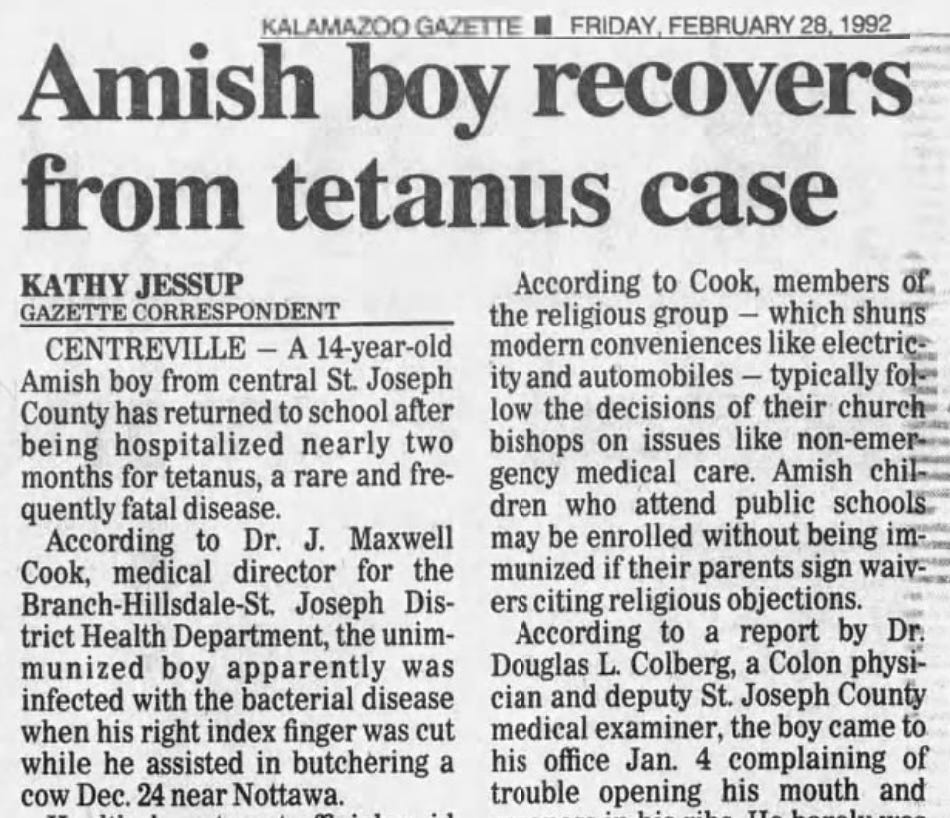
It shouldn’t surprise you that there have been some cases.
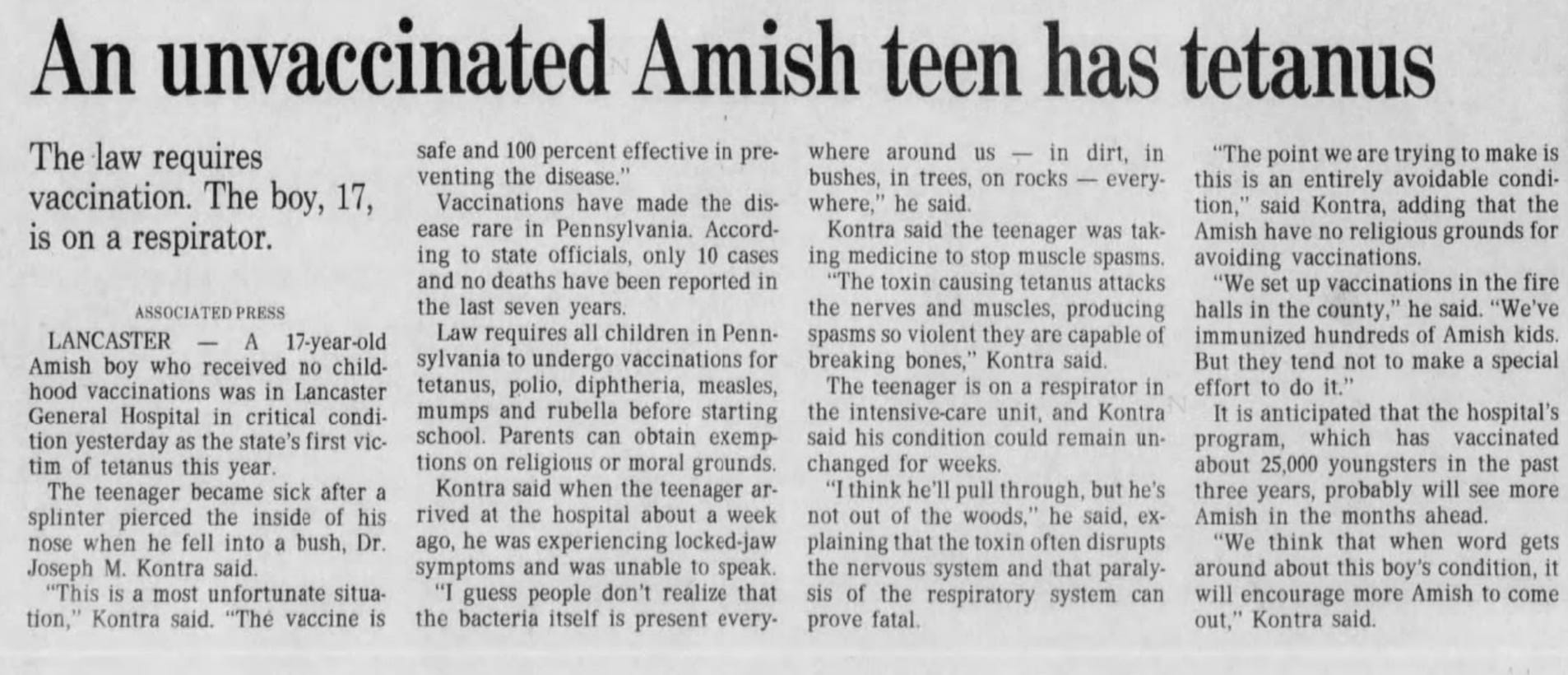
Most after what seem like very minor wounds too…
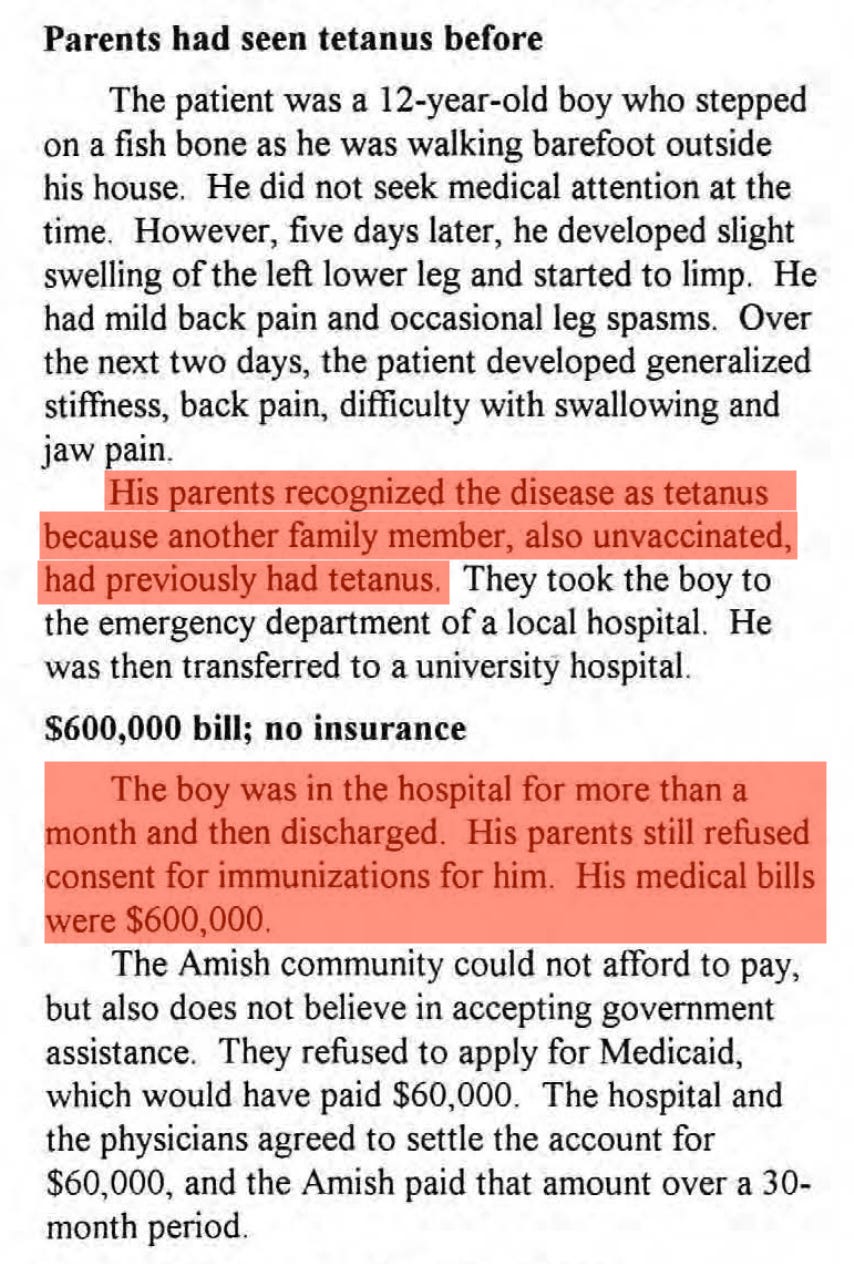
In addition to newspaper reports, one study found at least five cases of tetanus in unvaccinated kids in Pennsylvania between 2006 and 2015. Four of the kids were Amish.
“An 11-year-old unvaccinated Amish boy presented to the emergency department of a community hospital with trismus 7 days after a fall complicated by a skin and soft-tissue infection overlying his knee injury. He was transferred with a clinical diagnosis of tetanus for additional surgical management of his knee wound. He was given tetanus immunoglobulin (peripherally), tetanus toxoid vaccine, and metronidazole. He also received cefazolin and underwent vacuum-assisted closure of the knee wound. The patient was discharged home on day 22 of hospitalization with NGT feeds as a result of his continued oropharyngeal dysphagia.”
Pediatric Tetanus in Central Pennsylvania
Fortunately, all five kids survived, but “the costs were significant.”
And we are not just talking about money…
“Most of the victims were bright active boys, aged from 6 to 18 years, and they were doomed to die the most awful death known to medical science, a death the agony of which is probably not paralleled even by the tortures of the Inquisition.”
Fourth of July Injuries and Tetanus. The Seventh Annual Compilation by the Journal of the American Medical Association.
Like many other vaccine preventable diseases, having tetanus is horrible!
Remember, tetanus causes you to have severe muscle spasms, which is why it is also called lockjaw, painful muscle stiffness, seizures, and eventually death if not treated.
And ironically, these kids with tetanus eventually do get a tetanus vaccine. It is part of the treatment, along with tetanus immunoglobulin and antibiotics, for a tetanus infection!
Other Tetanus Cases Among the Amish
In addition to these cases, there was the recent case of the unvaccinated pregnant Amish mother shortly after she delivered getting tetanus!
“The patient, a woman aged 30 years, is a member of an Amish community. In late June, she delivered a child at home, assisted by an unlicensed community childbirth assistant. She had never received a vaccination for tetanus. Delivery was complicated by breech presentation, but no birth trauma, unsterile conditions, or other complications were reported. Nine days postpartum, the patient experienced facial numbness and neck pain, which progressed over 24 hours to stiff neck and jaw and difficulty swallowing and breathing. She was admitted to the hospital where a clinical diagnosis of tetanus was made, and 6,000 international units of tetanus immunoglobulin were administered intramuscularly. Endotracheal intubation and mechanical ventilation were required. Her hospital course was complicated by seizures and a need for prolonged respiratory support. After approximately a month, the patient was stable and discharged home.”
Notes from the Field: Obstetric Tetanus in an Unvaccinated Woman After a Home Birth Delivery — Kentucky, 2016
It was the first case of obstetric tetanus in the United States in over 44 years!
These aren’t the only cases of tetanus among the Amish though. Understand that cases of tetanus in the Amish are greatly underreported!
There are almost certainly many more cases that we don’t know about.
Most notably, from 1968 to 2016 there were at least twelve tetanus deaths in counties with a high population of Amish residents, including:
Marshall County, Indiana
LaGrange County, Indiana
Wayne County Ohio
Crawford and Lancaster County, Pennsylvania
Vernon County, Wisconsin
And that’s just deaths.
There were likely many more cases of tetanus that required prolonged hospitalization in these communities too.
Why should you think about this?
If you have skipped or delayed your child’s tetanus vaccine, they have the same risk and could eventually get tetanus after a minor injury.
More on Tetanus
Notes from the Field: Obstetric Tetanus in an Unvaccinated Woman After a Home Birth Delivery — Kentucky, 2016
Centers for Disease Control and Prevention, National Center for Health Statistics. National Vital Statistics System, Mortality: Compressed Mortality File 1968-1978. CDC WONDER Online Database, compiled from Compressed Mortality File CMF 1968-1988, Series 20, No. 2A, 2000. Accessed at http://wonder.cdc.gov/cmf-icd8.html on Mar 2, 2026 5:13:40 PM
An Assessment of the Presence of Clostridium tetani in the Soil and on Other Surfaces
Thanks for writing this up.