
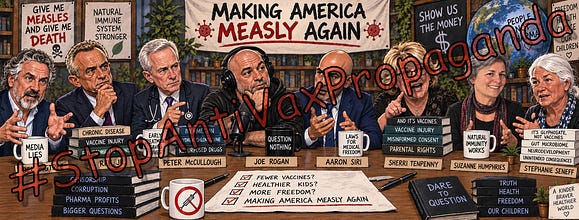

Update - New reports are that the child had a blood sugar of 700 in the emergency room, so may have presented with diabetic ketoacidosis, a life-threatening complication of type 1 diabetes.
Why do some people think that a baby has tragically died after getting 12 vaccines?
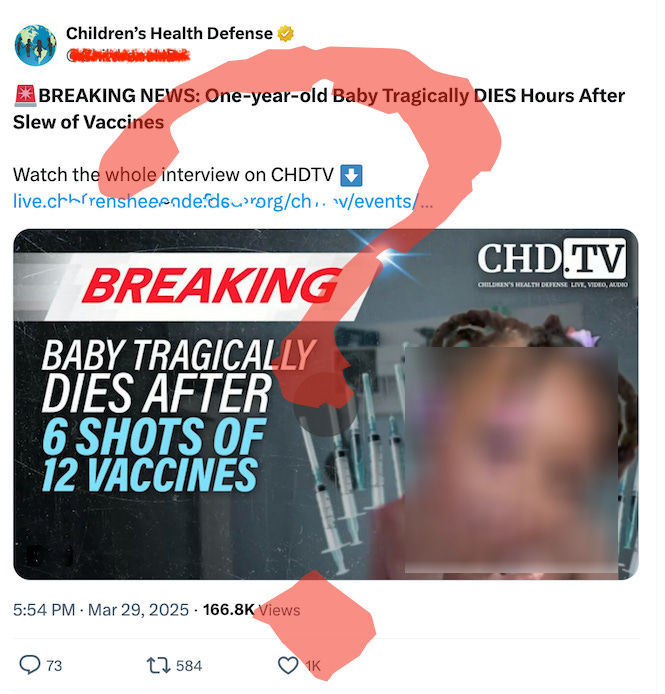
The usual suspects…
Did a Baby Tragically Die After Getting 12 Vaccines?
In this case, Children’s Health Defense, the organization that Bobby Kennedy started, is pushing the story.
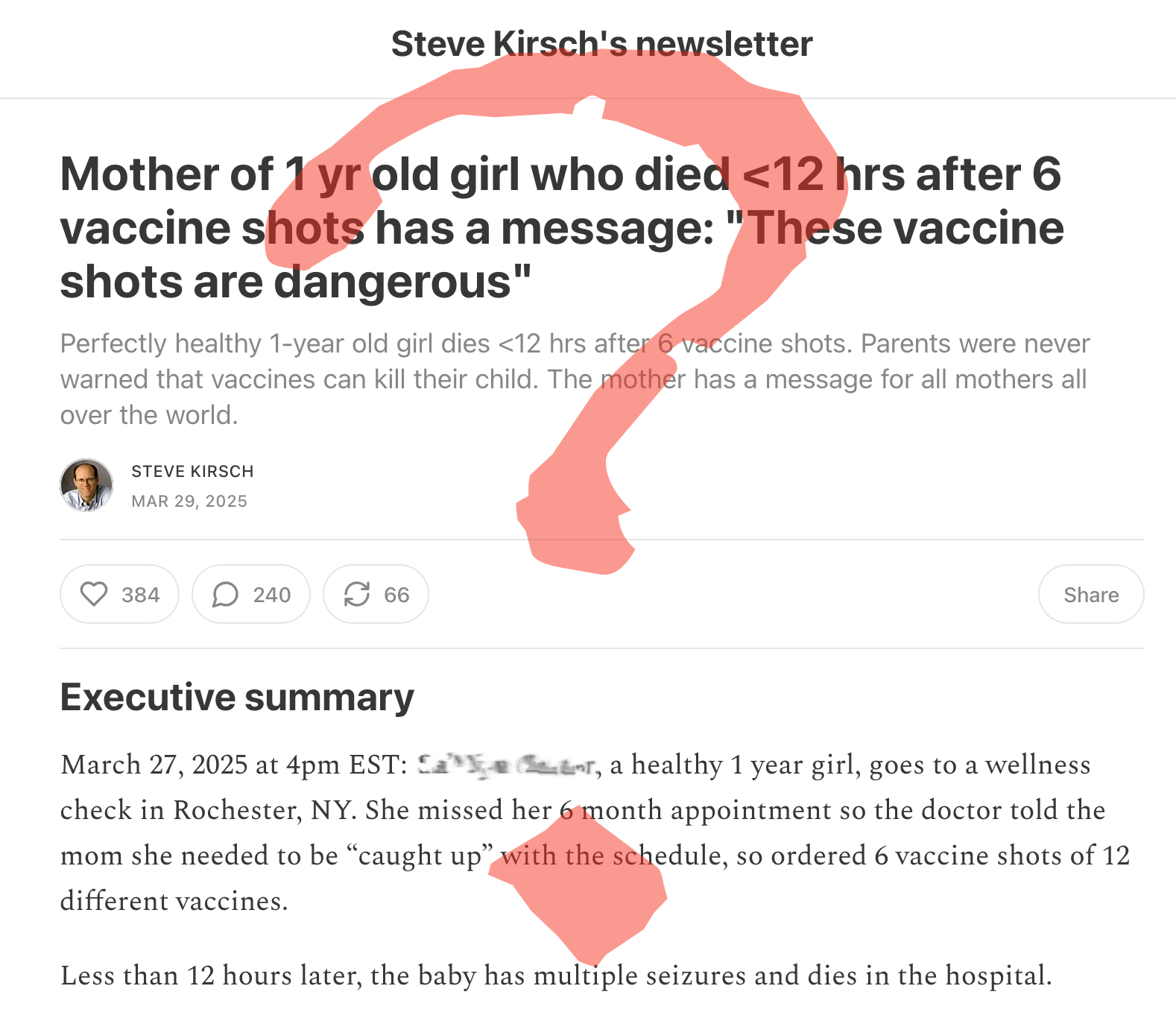
And not surprisingly, the story is being laundered across the social media accounts and sites of most anti-vaccine influencers.
What are they claiming?
That a healthy 12-month-old soon died after getting her vaccines.
Is there any evidence that the vaccines are to blame?
Not that we have seen…
So while these same folks called for more information and investigations after an unvaccinated child died with measles, blaming everything from pre-existing and comorbid conditions to being given the wrong antibiotic, we see none of that when they want to blame vaccines.
“It's only two days since your daughter passed away and you're sitting here telling the world your story.”
Polly Tommey
As they often do, we do see anti-vaccine influencers jump on the opportunity to take advantage of parents as they are grieving the loss of a child.
We do know that:
the child had a runny nose and cough at the time of her visit to her pediatrician
she had a rash on her abdomen
she was constipated
she had missed her six-month vaccines, so was behind
at this visit, she received the DTaP, HepB, IPV combination vaccine, Hib, Prevnar 20, MMR, chicken pox, and the hepatitis A vaccines — so 6 shots of 8 vaccines, not 12 vaccines
she had fluoride varnish applied to her teeth
Is any of that a contraindication to getting vaccinated?
Of course not.
While it sounds like she had a cold virus, without a high fever or other severe symptoms, that isn’t a contraindication to getting vaccinated. And of course, neither is being constipated.
Is there a contraindication to giving that combination of shots at one visit?
Nope. While they could have been spaced out over multiple visits, since she was already behind, there is a concern of getting even further behind, putting her at risk to get those diseases. Most importantly, though, it is considered safe to get multiple vaccines at one visit.
Next, it sounds like the family drove several hours from New York to Pennsylvania, where, at a bathroom break, they noticed she wasn’t breathing well and was having a seizure. They did CPR, she recovered some but was still lethargic and she was taken by ambulance to the hospital, where she had four more seizures. She soon died, as they were unable to resuscitate her while in cardiac arrest.
“When a sick infant or toddler presents to their primary care physician, type I diabetes is generally not high on the list of possible diagnoses, given the relatively low incidence of the disease in this age group. Furthermore, the classical symptoms of polyuria and nocturia, polydipsia, polyphagia, and weight loss are often overlooked or ascribed to other causes until the disorder has progressed to frank diabetic ketoacidosis (DKA).”
The infant and toddler with diabetes: Challenges of diagnosis and management
A recent update also noted that she had a blood sugar of 700, which is very high. While we can’t make a medical diagnosis without more information, it is suspicious for a child who is suffering from DKA or diabetic ketoacidosis, a life-threatening complication of type 1 diabetes. A condition that is hard to diagnosis at this age, as it would be easy for the parent of a toddler to miss the classic diabetes symptoms of increased urination and increased thirst. Still, we don’t know what her blood sugar was when she first arrived at the ER, so it could just be from all that was happening at the time.
It is a very sad story.
Her death is tragic.
It shouldn’t be used to scare other parents away from vaccinating and protecting their children though.
While vaccines can sometimes trigger febrile seizures, which are usually mild, they are not thought to cause other types of seizures.
“There is no evidence that vaccinations cause epilepsy in healthy populations. Vaccinations do not cause epileptic encephalopathies but may be non-specific triggers to seizures in underlying structural or genetic etiologies.”
Vaccination and childhood epilepsies
Over and over, studies have shown that vaccines do not cause seizures.
“Our results suggest that in most cases, genetic or structural defects are the underlying cause of epilepsy with onset after vaccination, including both cases with preexistent encephalopathy or benign epilepsy with good outcome. These results have significant added value in counseling of parents of children with vaccination-related first seizures, and they might help to support public faith in vaccination programs.”
Vaccination Triggers, Rather Than Causes, Seizures
What can cause deadly seizures?
Most of the childhood illnesses that vaccines can help prevent!
“A wide variety of CNS infections, including bacterial (e.g. typical bacterial meningitis, tuberculosis), viral (e.g. herpes simplex, HHV-6), parasitoses (e.g. cerebral toxoplasmosis, NCC, malaria), fungal (e.g. candidiasis, coccidioidomycosis, aspergillosis), and prion infections (CJD), can lead to status epilepticus.”
Infections, inflammation and epilepsy
Measles, mumps, chicken pox, Hib, pertussis, tetanus, meningococcal disease, pneumococcal disease — they can all cause seizures, which is why they are so deadly.
Especially as she was behind on her vaccines, before jumping on vaccines as a cause, we might instead think of Hib or pneumococcal meningitis.
Or HHV-6, which is extremely common in young children and although typically thought to be mild, has been linked to encephalitis and status epilepticus.
And let’s not forget all the cases of influenza-associated encephalopathy or encephalitis (IAE) we have been hearing about.
“CDC has received recent anecdotal reports of critically ill children with influenza-associated ANE, including several deaths, during the 2024–25 influenza season.”
Reports of Encephalopathy Among Children with Influenza-Associated Mortality — United States, 2010–11 Through 2024–25 Influenza Seasons
These children can have the rapid onset of encephalopathy and refractory seizures.
Ideally, we wouldn’t be trying to guess at a cause at all.
We are only made to talk about this baby because time and again anti-vaccine influencers prey on parents when their children die. Very often, they find them through social media posts and get them to think that vaccines were the cause, creating new vaccine injury stories to boost their page views.
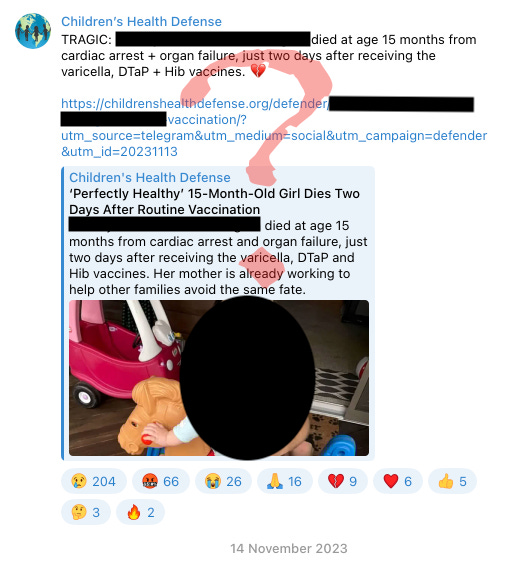
Not surprisingly, they rarely give follow up on these vaccine injury stories.
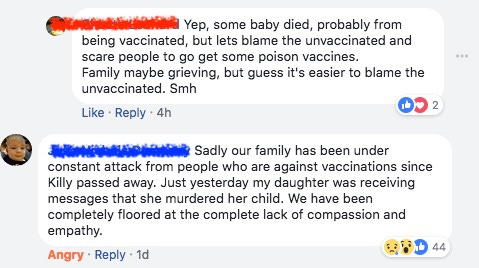
If they did, or you did a little research on your own, you would see that vaccine deaths truly are rare.
“Vaccines are rigorously tested and monitored and are among the safest medical products we use. Millions of vaccinations are given to children and adults in the United States each year. Serious adverse reactions are rare. However, because of the high volume of use, coincidental adverse events including deaths, that are temporally associated with vaccination, do occur. When death occurs shortly following vaccination, loved ones and others might naturally question whether it was related to vaccination. A large body of evidence supports the safety of vaccines, and multiple studies and scientific reviews have found no association between vaccination and deaths except in rare cases… making general assumptions and drawing conclusions about vaccinations causing deaths based on spontaneous reports to VAERS - some of which might be anecdotal or second-hand - or from case reports in the media, is not a scientifically valid practice.”
Deaths following vaccination: What does the evidence show?
But while vaccines are safe, with few serious risks, you really should be careful of anti-vaccine influencers if you want to keep your family safe and healthy…
References
Craiu D, Rener Primec Z, Lagae L, Vigevano F, Trinka E, Specchio N, Bakhtadze S, Cazacu C, Golli T, Zuberi SM. Vaccination and childhood epilepsies. Eur J Paediatr Neurol. 2022 Jan;36:57-68. doi: 10.1016/j.ejpn.2021.11.014. Epub 2021 Dec 3. PMID: 34922162.
Scheffer IE. Vaccination Triggers, Rather Than Causes, Seizures. Epilepsy Curr. 2015 Nov-Dec;15(6):335-7. doi: 10.5698/1535-7511-15.6.335. PMID: 26633955; PMCID: PMC4657773.
Measles seizure risks outweigh rare vaccine side effects. https://factcheck.afp.com/doc.afp.com.374Z9G2
Vezzani A, Fujinami RS, White HS, Preux PM, Blümcke I, Sander JW, Löscher W. Infections, inflammation and epilepsy. Acta Neuropathol. 2016 Feb;131(2):211-234. doi: 10.1007/s00401-015-1481-5. Epub 2015 Sep 30. PMID: 26423537; PMCID: PMC4867498.
Bartolini L, Theodore WH, Jacobson S, Gaillard WD. Infection with HHV-6 and its role in epilepsy. Epilepsy Res. 2019 Jul;153:34-39. doi: 10.1016/j.eplepsyres.2019.03.016. Epub 2019 Mar 29. PMID: 30953871.
Fazal A, Reinhart K, Huang S, et al. Reports of Encephalopathy Among Children with Influenza-Associated Mortality — United States, 2010–11 Through 2024–25 Influenza Seasons. MMWR Morb Mortal Wkly Rep 2025;74:91–95. DOI: http://dx.doi.org/10.15585/mmwr.mm7406a3.
Scary Reports of Deaths Following COVID-19 Vaccination Aren’t What They Seem. https://www.muhealth.org/our-stories/scary-reports-deaths-following-covid-19-vaccination-arent-what-they-seem
Miller ER, Moro PL, Cano M, Shimabukuro TT. Deaths following vaccination: What does the evidence show? Vaccine. 2015 Jun 26;33(29):3288-92. doi: 10.1016/j.vaccine.2015.05.023. Epub 2015 May 23. PMID: 26004568; PMCID: PMC4599698.
Weiss SL, Alexander J, Agus MS. Extreme stress hyperglycemia during acute illness in a pediatric emergency department. Pediatr Emerg Care. 2010 Sep;26(9):626-32. doi: 10.1097/PEC.0b013e3181ef0488. PMID: 20805780; PMCID: PMC4381194.
Daneman D, Frank M, Perlman K, Wittenberg J. The infant and toddler with diabetes: Challenges of diagnosis and management. Paediatr Child Health. 1999 Jan;4(1):57-63. doi: 10.1093/pch/4.1.57. PMID: 20212991; PMCID: PMC2828228.