


We have been hearing a lot about asymptomatic pertussis infections lately, especially as they relate to our new DTaP and Tdap vaccines.
“In our study, based on ELISA serology, the infectivity rate among family members was 83%, but 46% of those infected were asymptomatic.”
Intrafamilial spread of pertussis
It’s important to understand that the phenomenon of asymptomatic pertussis infections is not new though.

In the study, Intrafamilial spread of pertussis, they found that 46% of the secondary cases were asymptomatic and many were vaccinated - with a DPT vaccine. And many others actually had a history of having a natural pertussis infection!
Importantly, know that these asymptomatic cases are simply people who tested positive for pertussis. They are not people who are sick with any of the symptoms of pertussis.
Asymptomatic Pertussis Infections
Also know that it wasn’t just one old study that came to this conclusion.
“In a recent local epidemic in eastern Finland, we found asymptomatic individuals with positive cultures and serologic findings who remained healthy without antibiotic therapy. We think that serologic responses in asymptomatic persons represent a natural booster phenomenon continuously occurring in relatives of patients with pertussis and thus maintaining herd immunity. This view is supported by earlier reports suggesting that persisting immunity in vaccinated populations depends on subclinical or mild infections and that pertussis vaccines are more effective in protecting against disease than in protecting against infection.”
Intrafamilial spread of pertussis
And that they thought that these asymptomatic infections might be a good thing!
Are Asymptomatic People with Pertussis Contagious?
But are these asymptomatic people with pertussis contagious?
“An important issue is whether these asymptomatic persons can be a source of infection. Pertussis is transmitted by droplets, and we think that asymptomatic individuals with pertussis do not present a potential risk to their contacts, whereas those with an atypical cough play an important role in the dissemination of the disease.”
Intrafamilial spread of pertussis
Now that wouldn’t be a good thing…
“Our results demonstrate a high prevalence of subclinical infection in household contacts of pertussis cases, which may play a substantial role in the ongoing transmission of disease.”
Asymptomatic Infection and Transmission of Pertussis in Households: A Systematic Review
And fortunately, that’s not what most studies have actually found!
“No shedding of Bordetella pertussis was detected in systematically collected environmental samples. Bordetella pertussis colonization can be deliberately induced and leads to a systemic immune response without causing pertussis symptoms.”
Controlled Human Infection With Bordetella pertussis Induces Asymptomatic, Immunizing Colonization
Instead, most have simply found asymptomatic pertussis infections, not symptomatic pertussis disease, and that those who are colonized aren’t actually shedding and may not be getting others sick!
“We have not directly inferred pertussis transmission, and acknowledge that a linear relationship may not exist between qPCR signal intensity and infectiousness.”
Asymptomatic Bordetella pertussis infections in a longitudinal cohort of young African infants and their mothers
Others have found that asymptomatic pertussis infections have likely always been common.
In fact, one study found that nearly 5% of asymptomatic, healthy school aged children in China tested PCR positive for pertussis.
“In the present study, pertussis outbreaks and patients with typical pertussis symptoms were not reported in the schools of the 4 provinces during a period of 3 months before and after the start of the study. These children were on their school summer holiday when they were recruited. Therefore, it is unlikely that these samples were collected during school outbreaks of pertussis.”
Prevalence of asymptomatic Bordetella pertussis and Bordetella parapertussis infections among school children in China as determined by pooled real-time PCR: A cross-sectional study
And they could not correlate these cases to any recent outbreaks, which is not what you would expect if asymptomatic pertussis infections were contagious!
What’s Causing Outbreaks of Pertussis?
But if asymptomatic pertussis infections aren’t causing outbreaks of pertussis, then what is?
Well, one factor could simply be that more cases are being detected by the pertussis PCR test that was introduced in 1989.
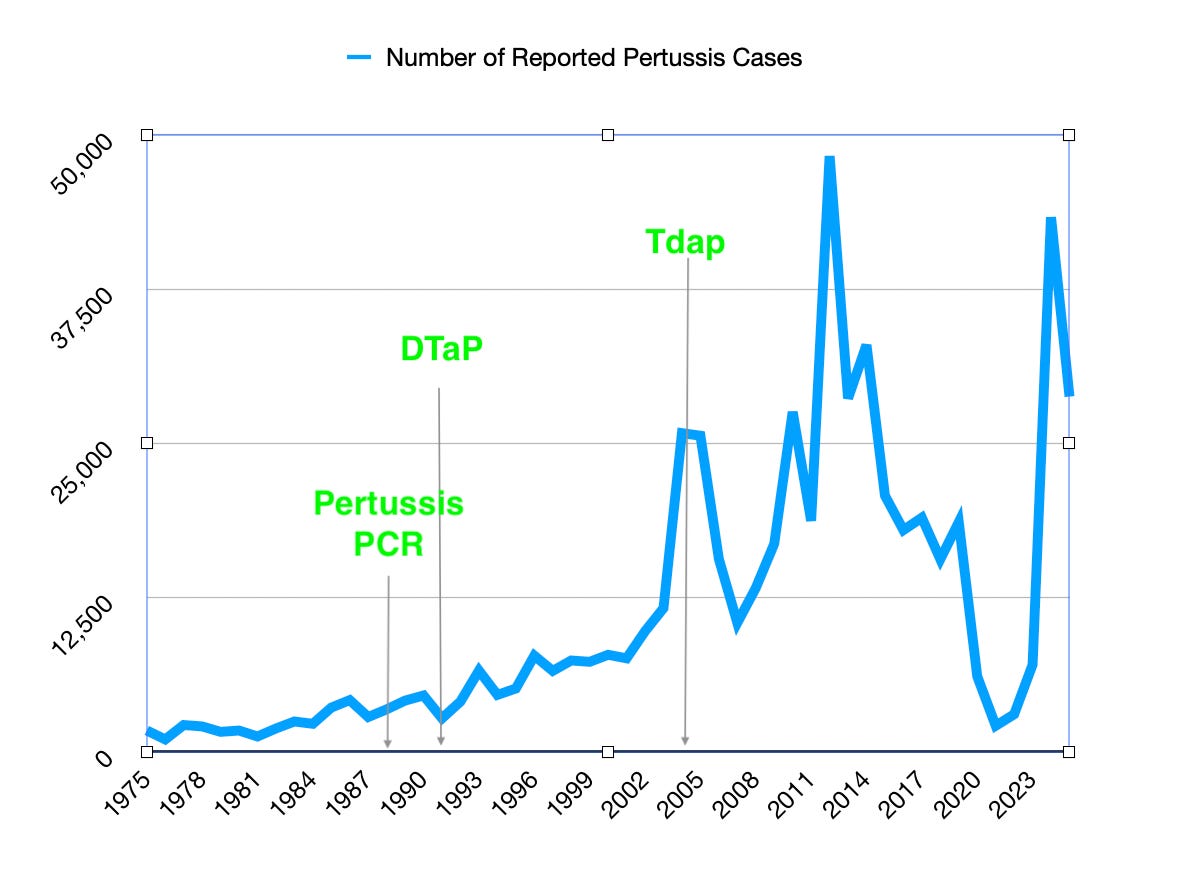
This detection bias would be responsible for finding more asymptomatic cases too.
And maybe even finding more false positives - symptomatic people with other reasons to have a cough, but who coincidentally test positive for asymptomatic pertussis.
“This report describes two hospital outbreaks and one community outbreak of respiratory illness during 2004--2006 in New Hampshire, Massachusetts, and Tennessee that were attributed initially to pertussis. However, subsequent investigations revealed negative or equivocal laboratory results and epidemiologic and clinical features atypical of pertussis, suggesting that pertussis was not the cause of these outbreaks. The findings in this report underscore the need for thorough epidemiologic and laboratory investigation of suspected pertussis outbreaks when considering extensive control measures.”
Outbreaks of Respiratory Illness Mistakenly Attributed to Pertussis --- New Hampshire, Massachusetts, and Tennessee, 2004--2006
This might also explain the rise in finding people with asymptomatic pertussis, as they didn’t seem to exist when they were looking for them by doing cultures.
“In order to determine whether healthy adults can be of importance for the spread of pertussis the nasopharyngeal flora of 391 healthy individuals working in close contact with children was investigated during the height of a pertussis epidemic. Only 1 carrier of Bordetella pertussis was found, even though all individuals were exposed to the organism during the study period through their work.”
The carrier state in pertussis
Also though, like cases of measles, it is likely that pertussis cases have been rising as we see an increase in vaccine hesitancy.

These are the people with full-blown pertussis.
These are the infants who are dying because they are sick with pertussis.
This is not to deny that there may be some problems with our pertussis vaccines.
But the answer to imperfect pertussis vaccines is not to skip getting vaccinated. It is to get vaccinated and protected with the best vaccines we have until we have better vaccines!
“We have summarized empirical evidence showing that, contrary to the prevailing view, pertussis vaccines confer long-term protection against transmission and disease, so that previously infected or vaccinated adults play a minimal role in transmission.”
The pertussis enigma: reconciling epidemiology, immunology and evolution
Vaccines that may not work perfectly, but still work very well!
More on Pertussis Infections
Do Pertussis Vaccines Work Against Pertactin-Negative Pertussis Bacteria?
Is Your Risk of Death from the Pertussis Vaccine Higher Than from the Disease?
Does Getting the DTaP Vaccine Make You More Susceptible to Pertussis?
Asymptomatic Infection and Transmission of Pertussis in Households: A Systematic Review
Asymptomatic Bordetella pertussis infections in a longitudinal cohort of young African infants and their mothers
Epidemiological evidence for herd immunity induced by acellular pertussis vaccines
Controlled Human Infection With Bordetella pertussis Induces Asymptomatic, Immunizing Colonization
The pertussis enigma: reconciling epidemiology, immunology and evolution
The antivaxers who are whining that it is absolutely awful that there are asymptomatic cases of pertussis [PCR positive] in the vaccinated and how dangerous this is are also the exact same antivaxers who spend their time claiming:
1. Positive PCR is meaningless and does not indicate an infection, and
2. Pertussis is an innocuous illness.
…Hypocrisy writ large.
I understand that this is just an anecdote, but when my youngest daughter was 2 1/2, and therefore not fully vaccinated for pertussis, she got it. From her hippie dippy crunchy preschool that did not require vaccines during a Washington state outbreak, 2009, that was huge. Multiple other kits at that preschool also came down with pertussis. She had a pretty bad cough, but I doubt the doctor would’ve tested her for pertussis if it hadn’t been for the big outbreak. She tested positive and was put on antibiotics proactively. Bad cough for about two weeks but slept well. Did not have any other symptoms.
Our 80 year-old neighbor across the street repeatedly told me how glad she was that my children were vaccinated because when she was five years old, she missed six months of kindergarten because of pertussis . No vaccines at the time.
My husband, my oldest daughter, and I had all been vaccinated within the last two years for Tdap or DTaP and none of us got any symptoms at all. Which meant that we didn’t miss any worker school. We didn’t suffer any debilitating coughing spells that cause broken ribs. We didn’t miss six months of kindergarten. We didn’t need to take antibiotics proactively.
So Dell can just jump in a lake. His ideas are bunco. Crazy balls.
#VaccinesWork
#VaccineSaveLives