


Do you need another explanation for rising autism rates, I mean, besides that it has nothing to do with vaccines?
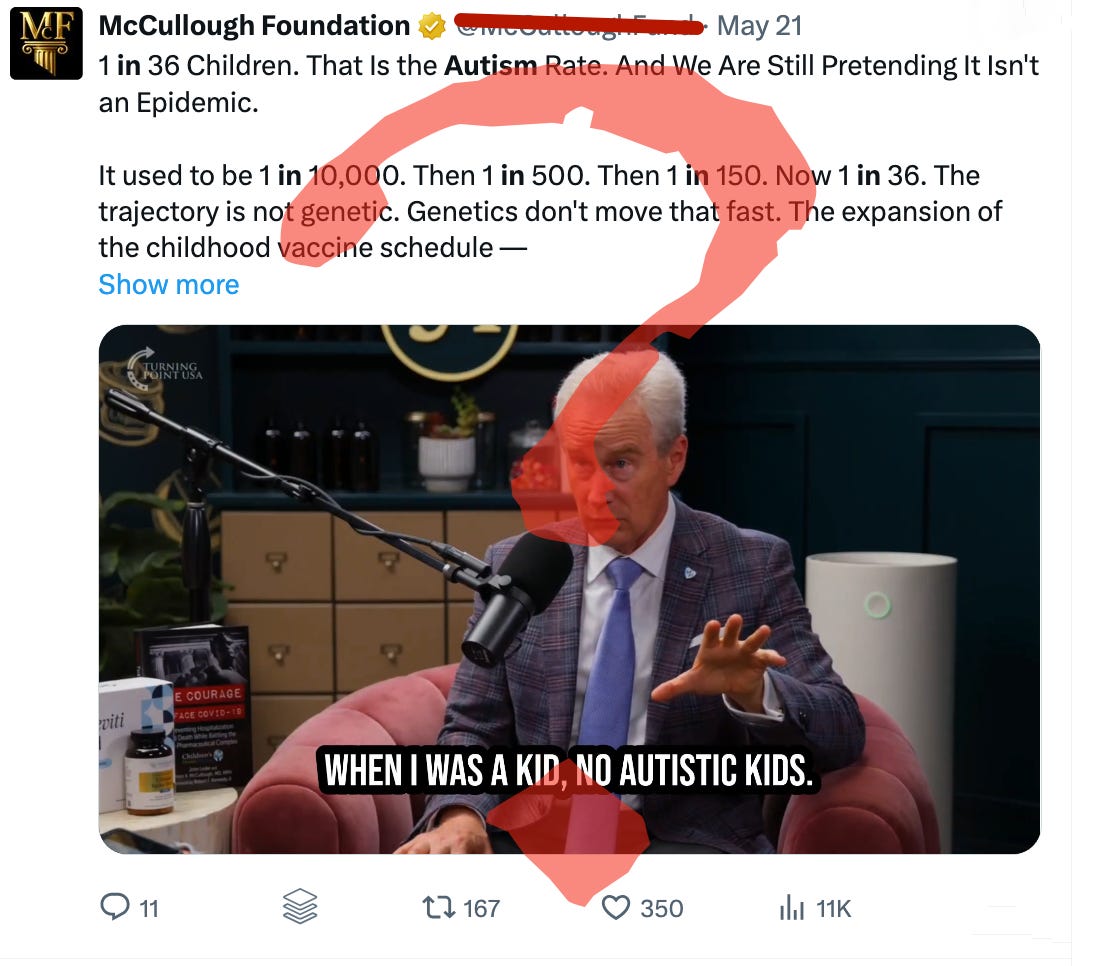
Another reason that refutes the misinformation put out by anti-vaccine influencers?
Another Explanation for Rising Autism Rates
How about the simple fact that more adults are now getting diagnosed with autism?
“The Mayfairs found a doctor willing to seriously test Billy – then 53 years old – for autism spectrum disorder. Once they got the official diagnosis is when the real work started.
Both Billy and Tami agreed that they had to relearn how to interact and communicate with one another; Tami likened it to learning another language. It was an adjustment for both parties, as Billy began to understand why or how he felt certain ways and Tami looked for support as the loved one of a person with autism.”
Billy Mayfair discusses beating Tiger Woods, autism diagnosis ahead of Principal Charity Classic
Adults like Billy Mayfair, who didn’t get diagnosed with autism until he was fifty-two years old.
“Increasingly adults over the age of 50 are receiving a diagnosis of autism spectrum condition. Growing up in a time when autism was poorly recognised, these adults have lived unknowingly with the condition and face readjustment.”
Living with autism without knowing: receiving a diagnosis in later life
But wait, how does that explain rising rates of autism in children?
Well, these are adults who missed getting diagnosed when they were kids, because the criteria was stricter and there was much less awareness and screening.
It helps confirm that the rise in autism rates hasn’t been because there are more people with autism, but simply because more of them are getting diagnosed.
“Although I had what I now recognise as autistic traits, such as stimming, it never occurred to me that I was autistic because I was born in the 1950s and autism wasn’t spoken about then.”
Peter Street
After all, these adults who are getting a late diagnosis have had autism all of their lives.
Sue Nelson - a former BBC science correspondent, she was diagnosed with autism at age 60
Tyler Barnett - he was misdiagnosed with anxiety, depression and bipolar disorder, but finally looked into getting diagnosed with autism on the suggestion of his 10-year-old daughter and it was life-changing. He was 42 years old.
Aly Muldowney - a former rugby player, he was diagnosed with autism at age 37 years after his son was also diagnosed.
Garret Mathews - a writer, his autism diagnosed was delayed until he was 67 years old.
Liane Holliday Willey - was diagnosed with autism at age 35 years as her daughter was being evaluated. She wrote the book Pretending to be Normal.
Sir Anthony Hopkins - the actor doesn’t actually have an official diagnosis, but his third wife strongly suspects that he is autistic.
Hannah Gadsby - a comedian who had a later-in-life autism diagnosis
Susan Boyle - the singer was diagnosed with autism when she was 51 years old after a life-time of being misdiagnosed as being brain-damaged.
Dan Akroyd - the actor was diagnosed with autism in the 1980s, when he was in his 30s.
Nina Hossain - a news anchor on British television network ITV, she was diagnosed with autism at age 50 years when her 16-year-old daughter was being tested.
LaVell Juricich - was diagnosed with autism at age 58.
Jennifer Taylor - was diagnosed with autism at age 54.
Tony Attwood - a psychologist who has written books about autism, his own diagnosis didn’t come until he was 74 years old!
Sarma Melngailis - the restaurateur and Bad Vegan star, she was diagnosed with autism at age 51.
John Elder Robison - was diagnosed with autism at age 40 after his son was diagnosed. He wrote the book Look Me in the Eye: My Life with Asperger’s.
Matt Cain - was diagnosed with autism at age 50.
Jamie Donovan - was diagnosed with autism at age 47.
Nicola Clark - was diagnosed with autism in her late 40s.
Sandra Thom-Jones - was diagnosed with autism at age 50, upon the “gradual realisation that the struggles my autistic children experienced in the world mirrored my own”
Jon Adams - was diagnosed with autism at age 52.
Peter Street - a poet, he was diagnosed with autism at age 64 when he sought therapy for PTSD.
Holden Thorp - a research scientist, he was diagnosed with autism in his 50s when he was the provost at Washington University in St. Louis
Kevin Chapman - a YouTuber, he was diagnosed with autism at age 40.
John Purnell - received a late diagnosis after his 10-year-old son was diagnosed with autism.
Jennifer Scriven - received a late diagnosis after her son was diagnosed with autism.
Fran Henderson - received a late diagnosis after her granddaughter was showing signs of being autistic.
If you read their stories, you will see some patterns.
“But for people on the spectrum, camouflaging involves hiding their autism traits in ways that can be stressful or physically uncomfortable. Some autistic people report that they force themselves to make eye contact and small talk. Others suppress an urge to rock or flap their hands, a type of repetitive behavior.
Some studies show that many people on the spectrum, particularly women, camouflage in social situations, and that time spent masking can be harmful to mental health.”
An Autism Diagnosis in Middle Age Answers Decades of Questions
A late diagnosis often means a life-time of struggling while camouflaging, masking, and being misdiagnosed with other conditions.
What else?
Many of these late diagnosed autistic adults have autistic children.
More Adults Are Being Diagnosed with Autism
But just how many more adults are being diagnosed with autism?
“The largest increase over the 9 years was in the 25- to 34-year age group (195%), and the smallest increase was in the 55- to 64-year age group (45%).”
Prevalence of Autism Among Medicaid-Enrolled Adults
While more autistic adults are getting diagnosed every year, it is still clear that many, especially seniors, are still being missed.
“Overall, we estimated that 1 in 45 adults (95% SI, 41, 51), ages 18–84 years, are living with ASD.”
National and State Estimates of Adults with Autism Spectrum Disorder
In addition to providing support to autistic people, we should be working to diagnose everyone in the lost generation of autistic adults, not spend more time on propaganda trying to associate vaccines with autism.
More on Autistic Adults
Getting Diagnosed With Autism As an Older Teen Or Young Adult
How Anti-Vaccine Influencers Observe Autism Acceptance Month
Why Are Anti-Vaccine Influencers Obsessed With the Movie Rain Man?
Three Reasons You Should Avoid Going to Anti-Vaccine Autism Conferences
Autism Rates Are Now 1 in 36. Here’s Why That Is a Good Thing.
An Autism Diagnosis in Middle Age Answers Decades of Questions
A Lost Generation: Growing Up With Autism Before The “Epidemic”
Identifying the lost generation of adults with autism spectrum conditions
National and State Estimates of Adults with Autism Spectrum Disorder
Prevalence of neurodivergence in neuropsychiatric conditions: cross-sectional study
Living with autism without knowing: receiving a diagnosis in later life
‘Diagnosis is rebirth’: women who found out they were autistic as adults
They Were Diagnosed With Autism as Adults. It Has Changed Their Lives.
‘All my life suddenly made sense’: how it feels to be diagnosed with autism late in life
‘I was different, not broken’: how my autism diagnosis changed my life
Autism in Middle and Old Age: What Do We Know, What Do We Need to Know?
Reflecting on your experiences and identity after a late diagnosis
Knowing Why: Adult-Diagnosed Autistic People on Life and Autism
Loving Lampposts: Accepting and Understanding Neurodiversity